
Learn · Iron Meteorites
Muonionalusta and Aletai are two of the iron meteorites collectors most often see as etched slices. Both show a Widmanstätten pattern, both are finds, and both were recovered as many separate masses. They come from different asteroid cores, sit in different chemical groups, and tell very different stories: one emerged from the glacial till of Swedish Lapland, the other lies scattered in multi-tonne masses across roughly 425 km of northern China.
The short answer
Muonionalusta is recorded in the Meteoritical Bulletin as Iron, IVA, found in 1906 in Sweden, with a recorded mass of 230 kg. Aletai is recorded as Iron, IIIE-an, found in 1898 in Xinjiang, China, with a recorded mass of 74 tonnes. On an etched face the quickest way to tell them apart is the width of the bands: Muonionalusta shows a tight, fine lattice of narrow kamacite plates, while Aletai's plates are about three times broader.
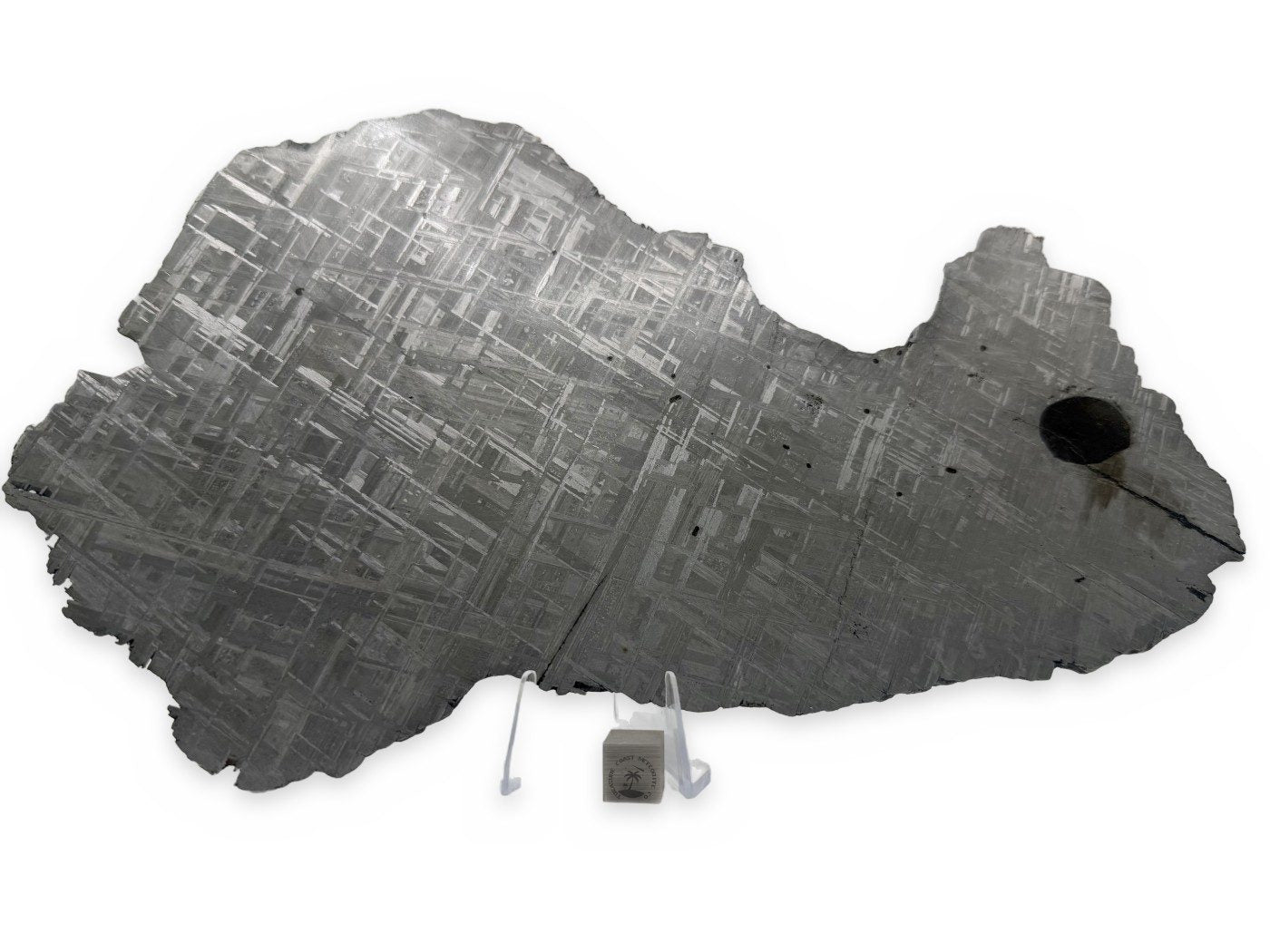
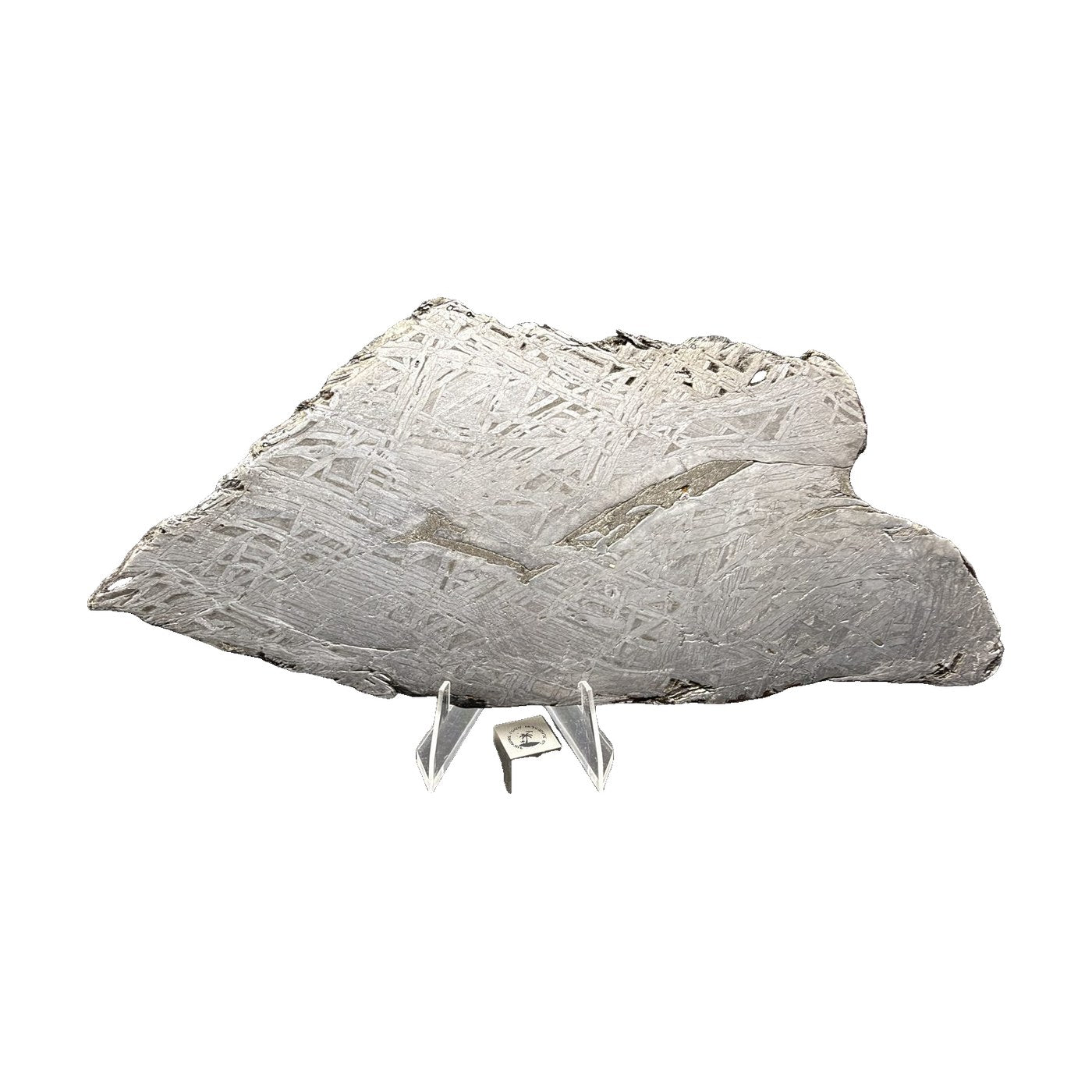
Muonionalusta and Aletai compared
The Meteoritical Bulletin Database records iron meteorites by chemical group only, so structural terms such as fine or medium octahedrite come from the cited sources, not the database entries. The octahedrite band-width ranges are those set out in Buchwald's Handbook of Iron Meteorites (1975), as widely summarized.
Why the patterns look so different
Both meteorites formed as molten metal in the core of an asteroid. As that metal cooled over millions of years, low-nickel kamacite grew as plates inside high-nickel taenite along the faces of an octahedron. Etching a cut face with acid brings the plates into view. How wide they grow depends on the nickel and phosphorus in the metal and on how fast it cooled. Our Widmanstätten pattern guide covers the process in full.
In practice, Muonionalusta's plates are narrow enough that a slice shows a dense web of crossing lines, often cut by shock features such as Neumann bands. Aletai's broader plates read as a bolder, more open pattern, with plessite filling the spaces between them. If you set a slice of each side by side, the difference is visible at arm's length.
The patterns up close
Macro photographs of etched faces from our own specimens. Acid etching attacks kamacite and taenite at different rates, so the plates and the bands between them catch the light differently.
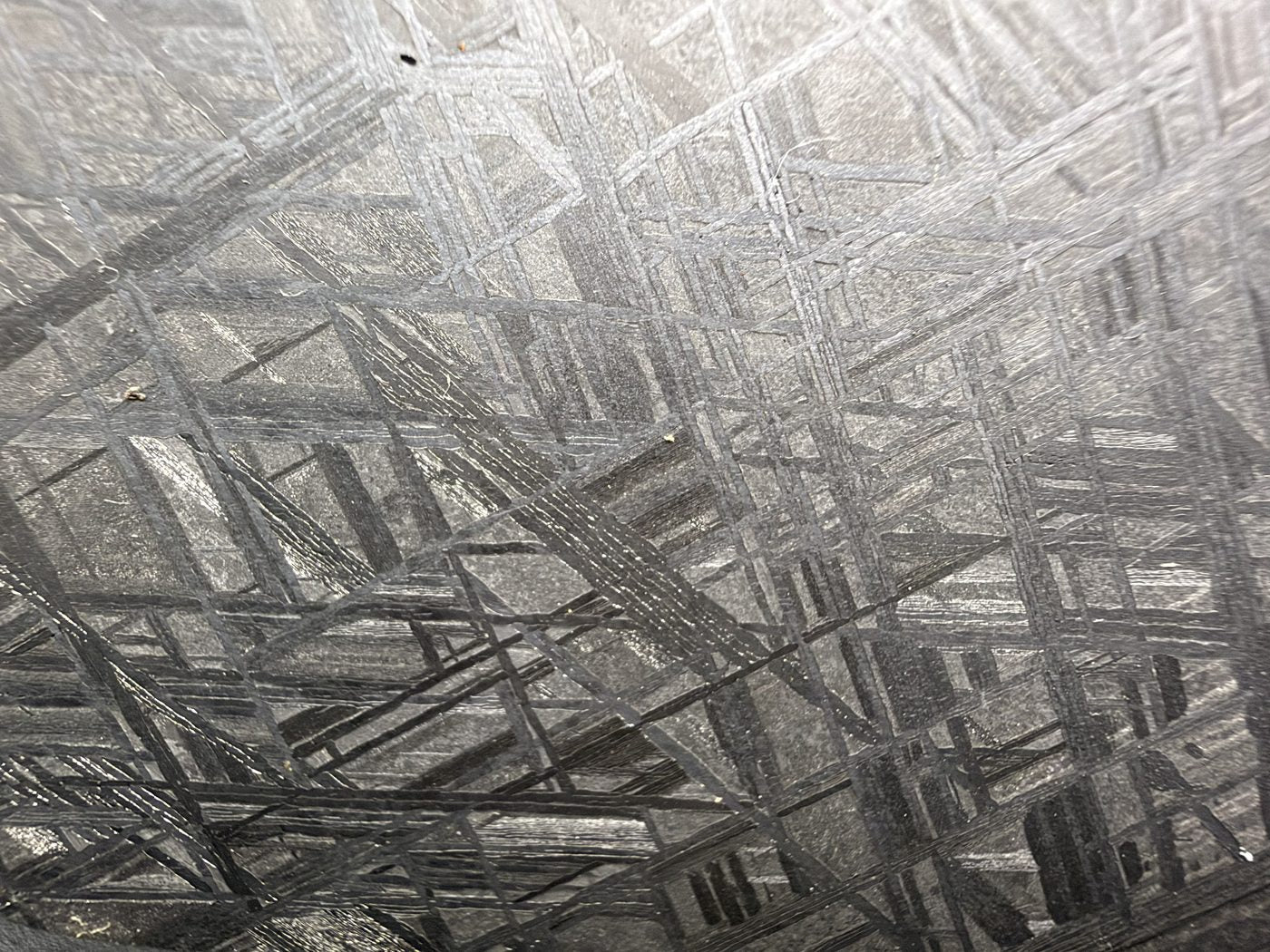
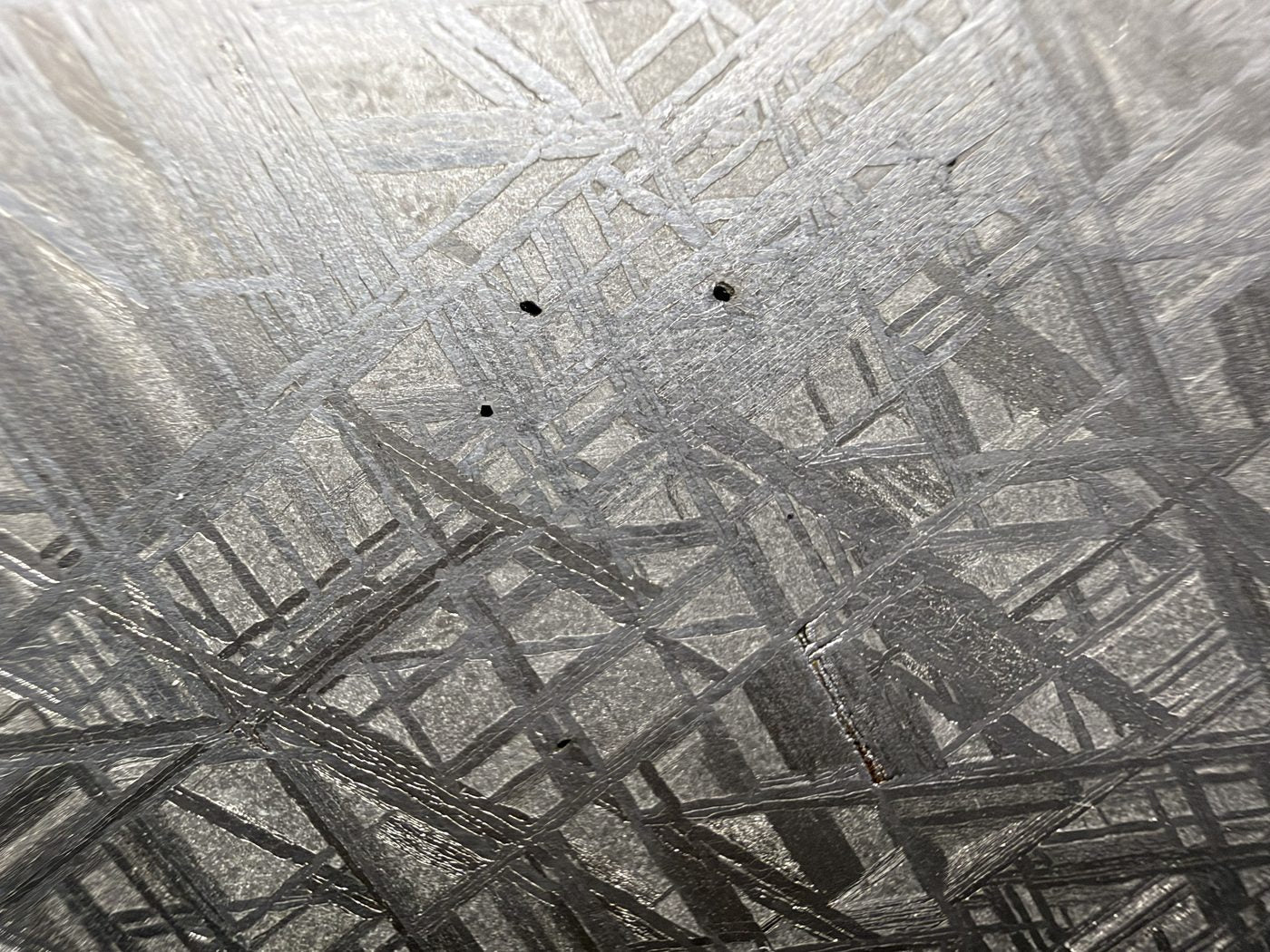
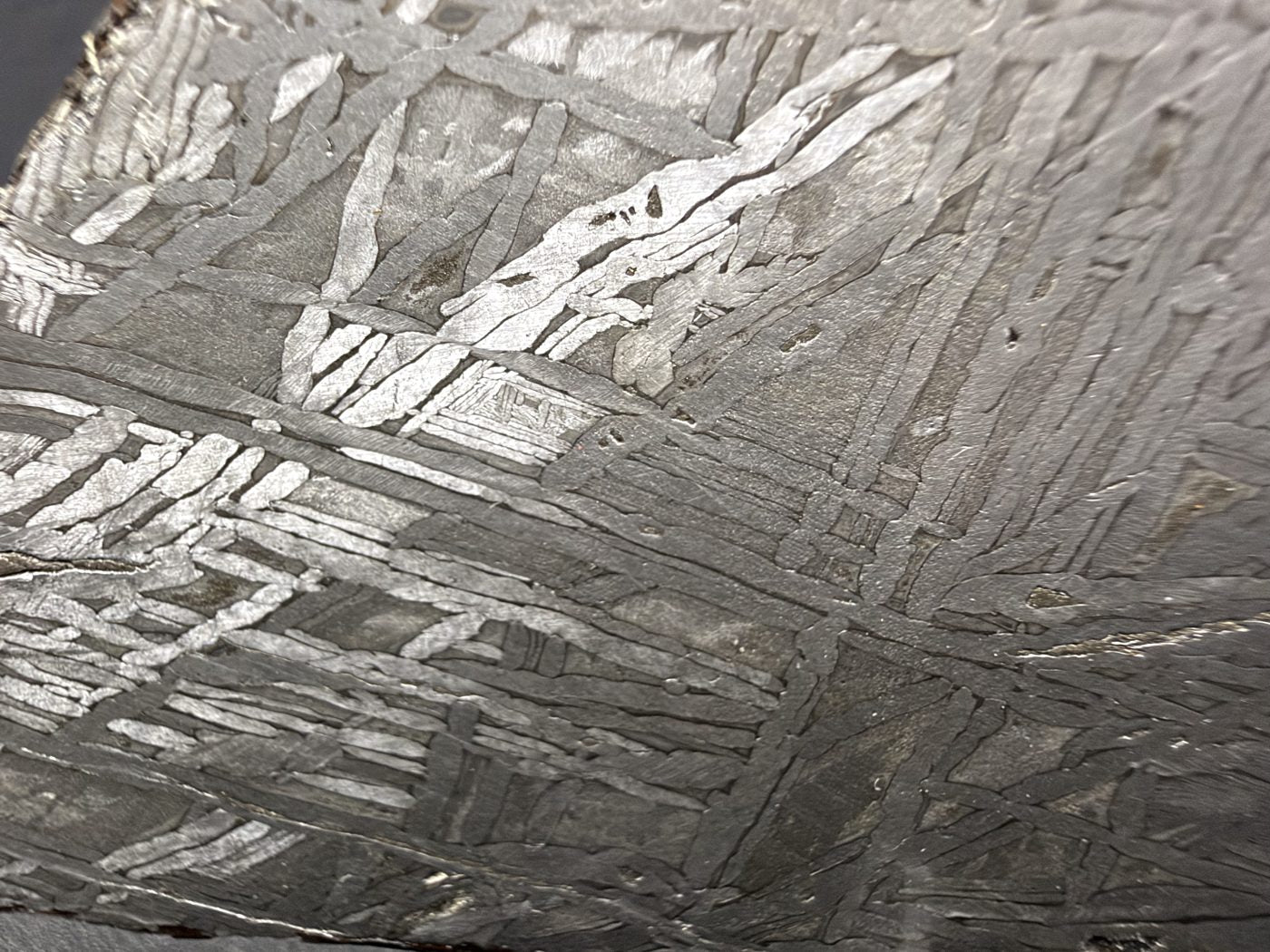
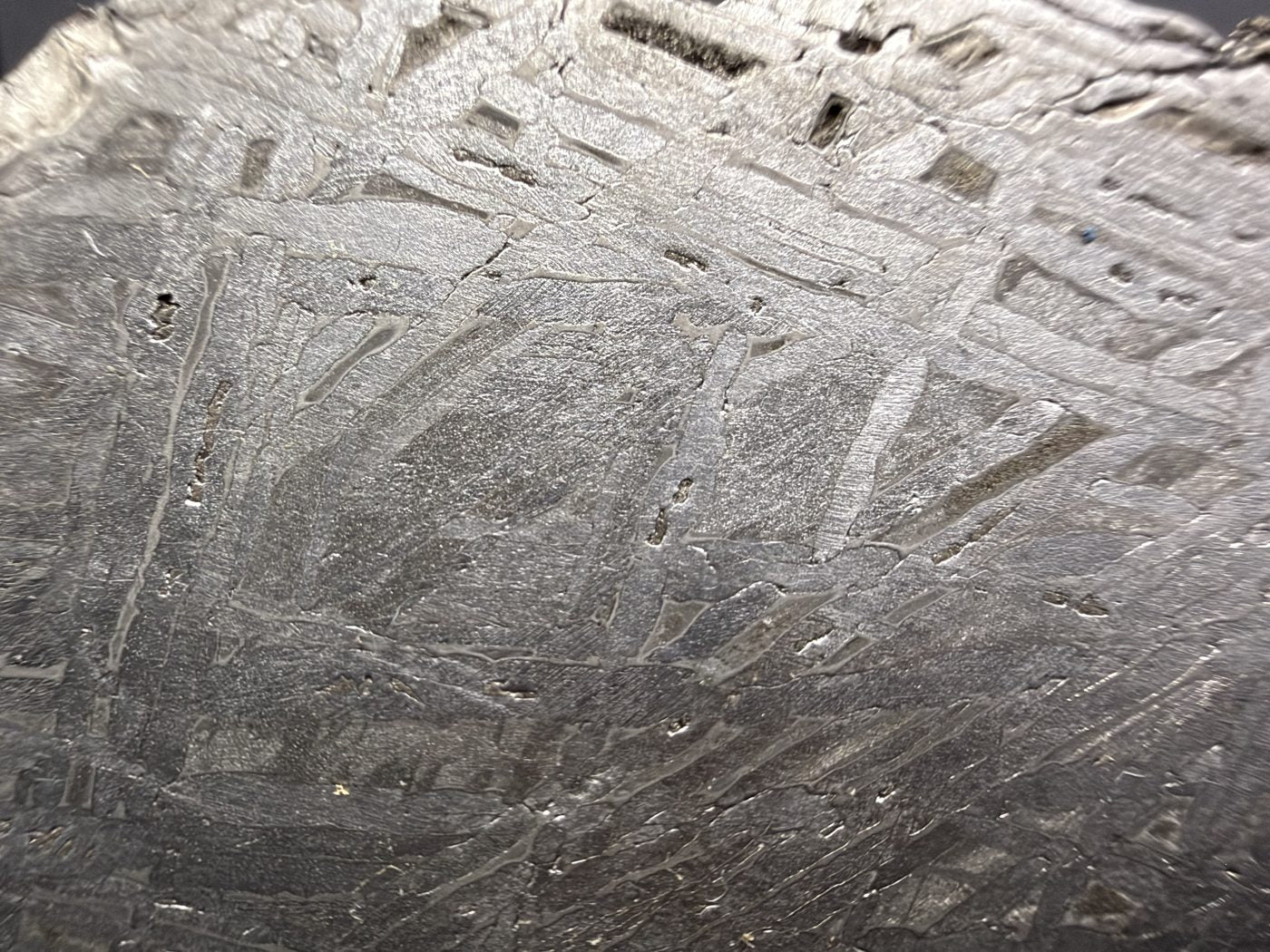
Macro photographs are not shown at the same magnification, so compare the pattern character rather than measuring band width from the images. Band widths given on this page come from the cited sources.
Two different parent bodies
Iron meteorites are grouped by the trace elements in their metal, and each magmatic group is thought to come from the core of a separate asteroid. Our guide to what an iron meteorite is sets out the groups.
Muonionalusta belongs to IVA, one of the largest iron groups, with 88 approved members as of November 2026. Lead isotope work on its troilite has made it one of the most discussed irons in studies of how early asteroid cores formed, although a later uranium study complicated that age (see the research section below).
Aletai belongs to IIIE, a small group, and is anomalous within it. The Bulletin notes it has the highest gold concentration in the group and an iridium level much higher than the group trend would predict. A 2023 study found the IIIE irons chemically and isotopically close to the much larger IIIAB group, possibly from a related crystallization sequence on the same or a closely related parent body.
The story
Muonionalusta: a boy, a cattle path and the ice ages
The first mass was found in 1906 in forest near the village of Kitkiöjärvi in Swedish Lapland, by a 10 year old boy tending cattle, according to the locality record. The meteorite takes its name from Muonionalusta, a place on the Muonio River along the border between Sweden and Finland.
The Bulletin records two of the early recoveries in its own pages: a mass of about 15 kg found on 15 August 1946 during earthwork at a building site, about 8 km east southeast of the 1906 site, and a single 6.20 kg mass found on 7 June 1963 by Carl Henriksson in excavated material used to build a causeway. That third mass went to the Swedish Museum of Natural History in Stockholm. Searching with metal detectors from the late 1980s turned up many more masses in the glacial till, some from several meters down. The masses had been on the ground long enough for glaciers to rework them.
Aletai: separate names, one meteorite
The first Aletai mass, Armanty, weighing 28 tonnes, was found in 1898. For more than a century the large irons of the region were recorded under separate names, including Armanty, Ulasitai, Xinjiang (b) and the provisional Xinjiang 008. The Bulletin records some of the discoveries. The Wuxilike mass was found by a local farmer half buried among rocks in a mountain valley, and heavy machinery was needed to move it to his home. The Akebulake mass lay on a remote mountainside, partly under a granite slab and marked with graffiti and cuts, until Aletai City officials built a road in 2011 and moved it to the city hall to protect it. In June 2021 a further 23 tonne mass was found buried under soil and grass in a pasture of Aletai County, close to the Wuxilike and Akebulake sites.
Chemical and petrographic work showed these masses to be paired, and in 2016 the Meteoritical Society brought them together under the single name Aletai, after the local county. The Bulletin compares the move to the grouping of several named irons under "North Chile" decades earlier, and asks authors to refer to individual pieces as, for example, "the Armanty mass of Aletai."
Sources: Meteoritical Bulletin 20 (1961), 28 (1963), 105 (2016) and 110 (2022), as reproduced in the Muonionalusta and Aletai database entries; Holtstam et al. (2003), cited below; Mindat locality record for Muonionalusta.
What the research reports
The Meteoritical Bulletin classifications are Iron, IVA for Muonionalusta and Iron, IIIE-an for Aletai, and nothing below replaces them. Muonionalusta's record begins as Iron-fine octahedrite in 1961; Aletai was published as Iron, IIIE in 2016 with IIIE-an now recommended. The findings below come from the authors' own samples and methods and are given as the studies state them. Where studies disagree, both sides are presented.
Muonionalusta: stishovite and a long stay on Earth
Holtstam, D., Broman, C., Söderhielm, J. and Zetterqvist, A. (2003). First discovery of stishovite in an iron meteorite. Meteoritics and Planetary Science 38, 1579 to 1583. The authors report stishovite, a high-pressure form of silica, in Muonionalusta, the first in any iron meteorite, and suggest it records shock in the IVA parent asteroid during an impact. They also cite a terrestrial age of more than 800,000 years from cosmogenic beryllium-10 and chlorine-36.
Muonionalusta: an early age for the IVA core
Blichert-Toft, J., Moynier, F., Lee, C.-T.A., Telouk, P. and Albarède, F. (2010). The early formation of the IVA iron meteorite parent body. Earth and Planetary Science Letters 296, 469 to 480. Lead isotopes in troilite inclusions gave an age of 4,565.3 ± 0.1 million years, which the authors describe as the oldest documented for any differentiated body at the time. They place the breakup of the IVA parent asteroid about 400 million years ago.
Brennecka, G.A., Amelin, Y. and Kleine, T. (2018). Uranium isotope ratios of Muonionalusta troilite and complications for the absolute age of the IVA iron meteorite core. Earth and Planetary Science Letters 490, 1 to 10. Measuring the uranium isotope ratio in Muonionalusta troilite directly, they found it varies and departs from the value the 2010 age assumed. They conclude the IVA core must be younger than about 4,563 million years. The 2010 figure should be read with this caveat.
Muonionalusta: structure and a newly characterized mineral
Vander Voort, G.F. and Schmidt, F.E. (2014). Microstructure of the Muonionalusta octahedrite meteorite. Microscopy and Microanalysis 20 (S3), 848, conference abstract. They describe a fine octahedrite with about 8.42 percent nickel, kamacite plates averaging 0.29 ± 0.05 mm wide, and kamacite crowded with shock features and Neumann bands.
Bindi, L. and Holtstam, D. (2026). Discovery and structural characterization of zolenskyite, FeCr2S4, in the Muonionalusta meteorite. Mineralogical Magazine 90, 176 to 180. They identify zolenskyite, a polymorph of daubréelite, in Muonionalusta for the first time and report its first single-crystal X-ray structure.
Aletai: the pairing and its chemistry
Meteoritical Bulletin No. 105 (2017). The Meteoritical Bulletin, No. 105. Meteoritics and Planetary Science 52, 2411. Submitted by Weibiao Xu and John T. Wasson, the entry pairs the northern Xinjiang irons, corrects the coordinates of the Armanty mass, and gives Wasson's analyses of five masses. It describes Aletai as an anomalous IIIE with the highest gold concentration in the group.
Aletai: a skipping path through the atmosphere
Li, Y., Li, B., Hsu, W., Jull, A.J.T., Liao, S., Zhao, Y., Zhao, H., Wu, Y., Li, S. and Tang, C. (2022). A unique stone skipping-like trajectory of asteroid Aletai. Science Advances 8, eabm8890. Combining petrology, trace element chemistry, beryllium-10 measurements and numerical modeling, the authors find that if Aletai entered as a single body, a shallow entry angle of roughly 6.5 to 7.3 degrees could produce its 430 km strewn field, with the body skimming the atmosphere like a stone skipping across water. More than half the recovered mass, 46 of 74 tonnes, lies within about 10 km of the northwest end, which they read as the direction of flight from southeast to northwest. From the beryllium-10 data they estimate the initial mass at more than 200 tonnes. They note that distant masses can also fail to be paired, or be suspected of having been moved by people.
Their 430 km figure differs slightly from the roughly 425 km in the Bulletin; both describe the same spread of masses.
Aletai: age and place among the IIIE irons
Chiappe, E.M., Ash, R. and Walker, R.J. (2023). Age, genetics, and crystallization sequence of the group IIIE iron meteorites. Geochimica et Cosmochimica Acta. Studying ten IIIE irons, they found Aletai chemically distinct from the other nine, and model it as a possible nonequilibrium mix of an evolved liquid and early formed solid. Tungsten isotopes gave a metal-silicate segregation age of 1.2 ± 0.8 million years after the first solids of the solar system for Aletai, and 1.6 ± 0.8 million years for the other IIIE irons.
Leya, I., Ammon, K. and Lin, Y. (2010). Noble gases in the Xinjiang (Armanty) iron meteorite: A big object with a short cosmic-ray exposure age. Meteoritics and Planetary Science 45, A118, conference abstract, followed by a full paper by Ammon, Leya and Lin in Meteoritics and Planetary Science 46 (2011). As the title states, the noble gases point to a large object with a short exposure to cosmic rays in space.
Choosing between them
Neither is better. They answer different collecting goals.
- Choose Muonionalusta for the classic fine-lattice etch, a find history going back to 1906, and the depth of published research on a single iron, from stishovite to the age debate.
- Choose Aletai for a bold, broad pattern, a classification shared with only one other approved meteorite, and a strewn field story measured in hundreds of kilometers.
- Own both and a pair of slices shows, better than any diagram, how cooling history and chemistry change the same basic structure.
Because Aletai's recorded mass is more than 300 times Muonionalusta's, our Aletai slices are priced lower per gram than our Muonionalusta. Every piece of either meteorite we sell is professionally stabilized by Brian McDonald and ships with a certificate of authenticity; coating details are given on each listing. Display stands shown in photographs are not included. For ongoing care, see do meteorites rust and how to care for and store a meteorite.
Frequently asked questions
- What is the difference between Muonionalusta and Aletai?
- They are different meteorites from different asteroid cores. Muonionalusta is classified in the Meteoritical Bulletin as Iron, IVA, found in 1906 in Sweden, with a recorded mass of 230 kg. Aletai is classified as Iron, IIIE-an, found in 1898 in Xinjiang, China, with a recorded mass of 74 tonnes. Muonionalusta shows a fine Widmanstatten pattern with kamacite bands about 0.3 mm wide; Aletai's bands are about 1 mm wide.
- How can I tell a Muonionalusta slice from an Aletai slice?
- Look at the width of the etched bands. Muonionalusta shows a dense lattice of narrow plates about 0.3 mm wide. Aletai shows broader plates, about 1 mm wide, giving a bolder pattern. A reputable seller will also name the meteorite and its classification, which you can check against the Meteoritical Bulletin entry.
- Is Aletai the same meteorite as Armanty?
- Yes. Armanty is the 28 tonne mass found in 1898. In 2016 the Meteoritical Society paired it with other irons from northern Xinjiang and gave them all the official name Aletai. Armanty, Ulasitai, Xinjiang (b), Xinjiang 008, Wuxilike and Akebulake are now synonyms or mass names of Aletai.
- What does IIIE-an mean?
- IIIE is a chemical group of iron meteorites defined by trace elements in the metal. The "an" suffix means anomalous: Aletai's chemistry departs from the group's trends, with the highest gold concentration in the group and an iridium level much higher than the trend predicts. As of November 2026, the Meteoritical Bulletin lists Aletai as 1 of 2 approved meteorites classified as Iron, IIIE-an.
- Is Muonionalusta the oldest meteorite?
- It is often described that way, based on a 2010 lead isotope age of 4,565.3 million years for its troilite. A 2018 uranium isotope study found that age relied on an assumed value that does not hold for Muonionalusta troilite, and concluded the IVA core must be younger than about 4,563 million years. The age remains a subject of research.
- Why is Aletai's strewn field so long?
- Its masses lie along a line of about 425 km according to the Meteoritical Bulletin, or about 430 km according to Li and colleagues (2022). Their modeling suggests that, if it arrived as a single body, Aletai entered at a shallow angle of about 6.5 to 7.3 degrees and followed a path like a stone skipping across water before breaking up.
- Are Muonionalusta and Aletai octahedrites?
- Yes, both show the octahedral Widmanstatten structure. Muonionalusta is a fine octahedrite, the term in its 1961 Bulletin record. Aletai's band width of about 1 mm falls in the medium octahedrite range on Buchwald's scale, and researchers describe its pattern as medium-sized. The Meteoritical Bulletin records iron meteorites by chemical group only.
- Does Treasure Coast Meteorite Co. sell Muonionalusta and Aletai?
- Yes. Muonionalusta and Aletai each have their own collection, and both appear in our iron meteorite collection. Every piece is professionally stabilized and ships with a certificate of authenticity. Treasure Coast Meteorite Co. is an IMCA member, #3323.

