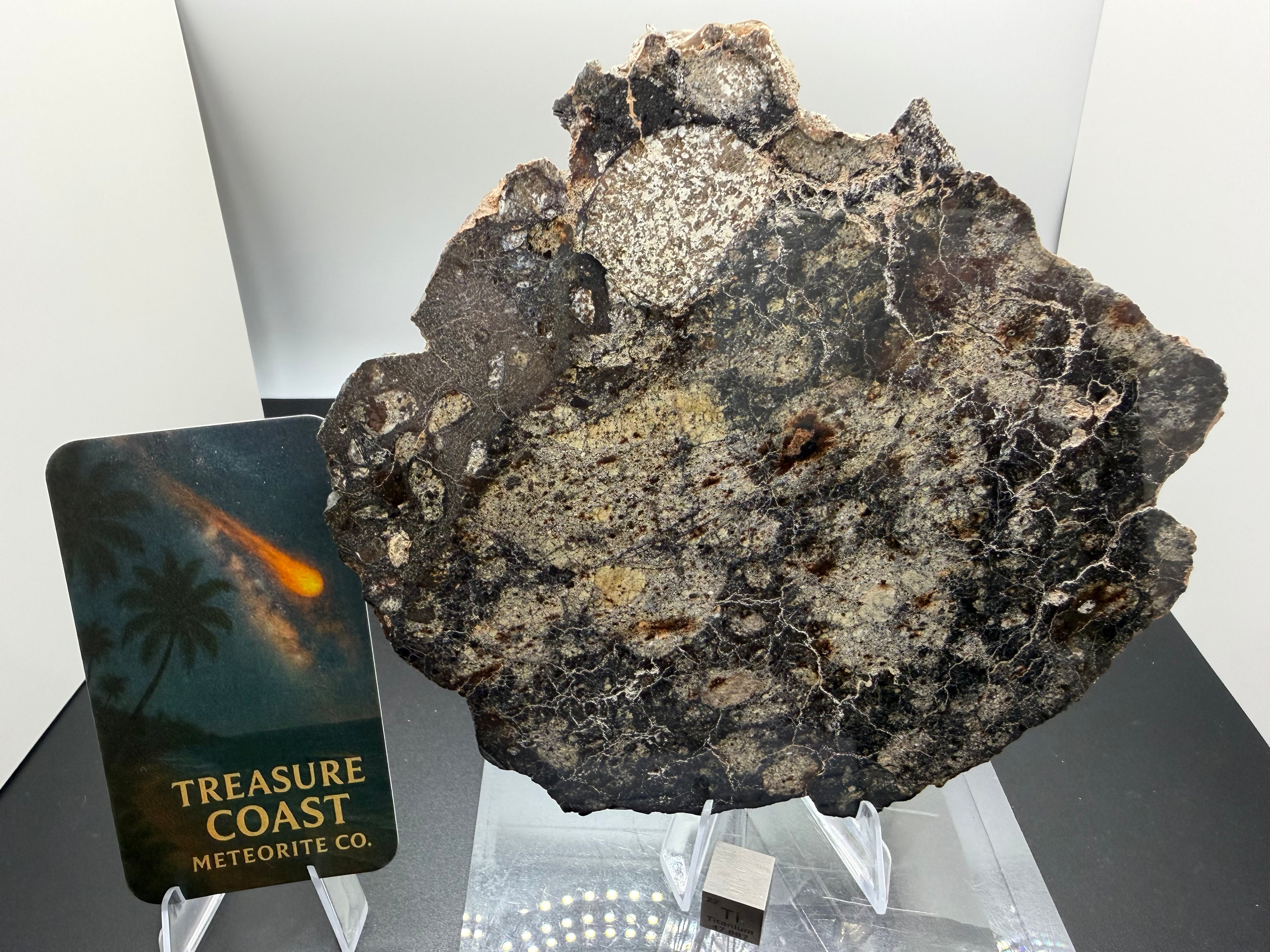
HED Meteorites
HED meteorites are a group of achondrites originating from asteroid Vesta, including eucrites, diogenites, and howardites. These differentiated meteorites provide insight into early planetary crust formation.

HED meteorites are a group of achondrites originating from asteroid Vesta, including eucrites, diogenites, and howardites. These differentiated meteorites provide insight into early planetary crust formation.
HED meteorites are a group of achondrites representing igneous material from a differentiated asteroid, most commonly linked to asteroid 4 Vesta. These meteorites preserve both crustal and deeper geological history from an early planetary body that formed, melted, and evolved during the early Solar System.
The HED group includes howardites, eucrites, and diogenites, each with distinct mineralogy, texture, and origin within the Vestan system. Some formed as basaltic crust, others as deeper plutonic material, while others are brecciated mixtures created by repeated impact events.
Each specimen offered by Treasure Coast Meteorite Co. is carefully sourced, authenticated, and selected for quality, stability, and collector appeal.
HED meteorites are a group of achondrites that originated from the differentiated asteroid Vesta. The name “HED” refers to howardites, eucrites, and diogenites—three closely related meteorite types formed through igneous processes.
Unlike primitive chondrites, HED meteorites represent material from a parent body that experienced melting, separation into layers, and crust formation early in Solar System history. As a result, they are more comparable to volcanic and crustal rocks found on Earth.
HED meteorites are widely accepted to originate from asteroid Vesta, one of the largest and most geologically complex bodies in the asteroid belt.
Data from NASA’s Dawn mission confirmed strong compositional matches between Vesta’s surface and HED meteorites found on Earth. Vesta is a differentiated body with a crust, mantle, and core structure, meaning HED meteorites provide direct samples of a small protoplanet that underwent planetary-style evolution.
These meteorites were ejected from Vesta by large impact events and eventually delivered to Earth over millions of years.
Eucrites are basaltic rocks formed from surface or near-surface lava flows on Vesta. They are typically fine-grained and often display brecciated textures or distinct clasts.
Diogenites originate deeper within Vesta’s crust and are composed primarily of orthopyroxene. They tend to be coarser-grained and represent slower cooling at depth.
Howardites are regolith breccias formed by impact mixing of eucrite and diogenite material on Vesta’s surface. These specimens often display visually striking mixtures of light and dark clasts.
Together, these three types represent different layers and geological processes within the same parent body.
HED meteorites occupy a unique position in meteorite collecting. They are:
For collectors, HED meteorites offer a direct connection to early planetary formation without the extreme rarity and cost associated with lunar or Martian material.
Because HED meteorites encompass multiple subtypes and textures, they provide a wide range of collecting opportunities:
Each specimen represents a different part of Vesta’s geological history, making them particularly appealing for collectors interested in planetary differentiation and impact processes.