

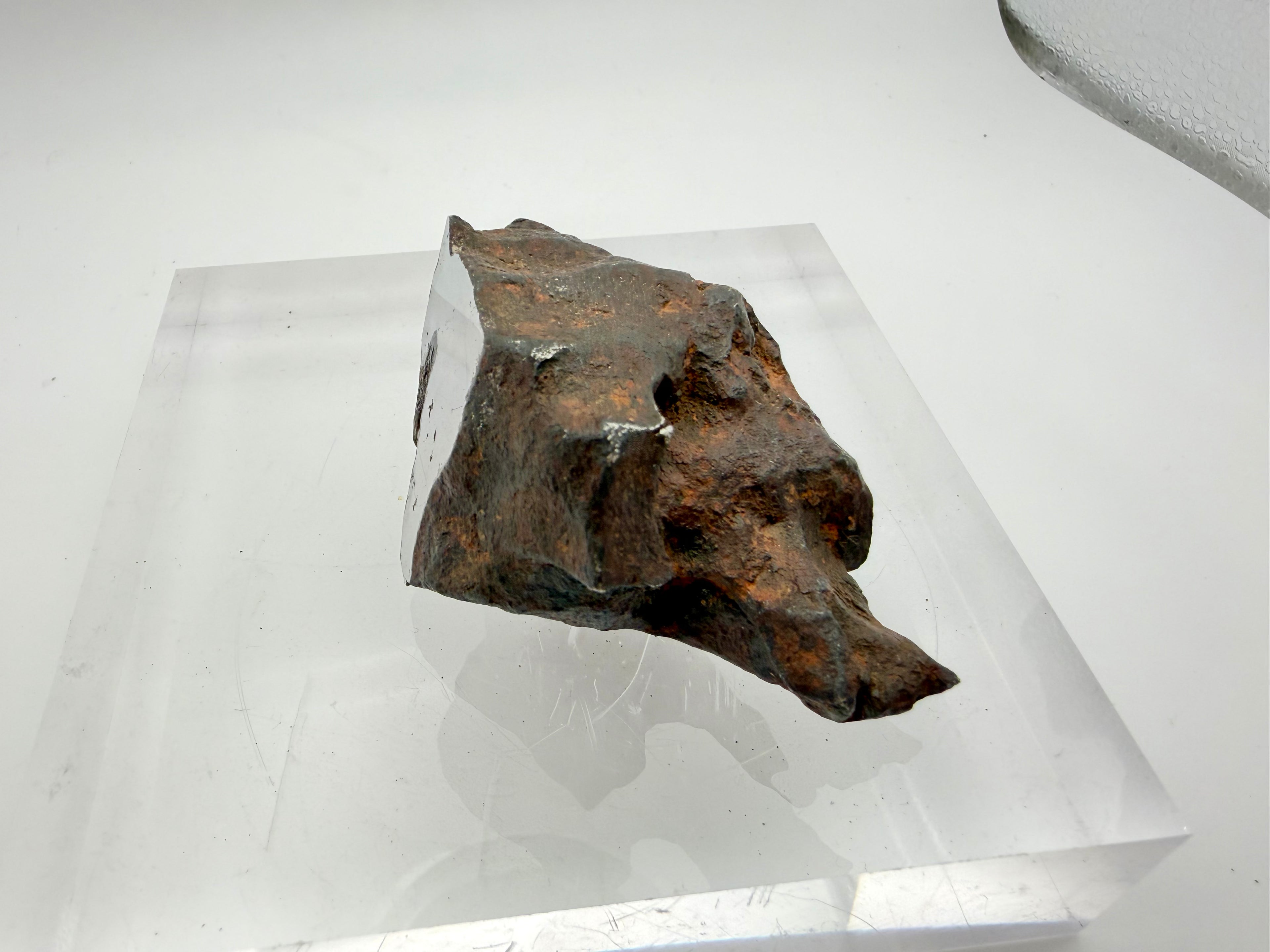
Gebel Kamil Iron Meteorite, Ungrouped Ataxite, 216.06g Shrapnel Fragment with Polished Window
$400.00 USD
Sale price
$400.00 USD
Regular price
Skip to product information


Gebel Kamil Iron Meteorite, Ungrouped Ataxite, 216.06g Shrapnel Fragment with Polished Window
Meteorite Details
Meteorite Name: Gebel Kamil
Subtype: Iron
Classification: Iron, ungrouped
Weight: 216.06 g
Year Found: 2009
Fall / Find: Find
Location: Egypt

$400.00 USD
Sale price
$400.00 USD
Regular price
A 216.06 g shrapnel fragment with a polished window
This 216.06 g Gebel Kamil specimen is a piece of the iron meteorite that blasted out the 45 m Kamil crater in southwestern Egypt. It is a jagged fragment with a rust-brown exterior and torn projections, with one face cut and polished into a window that shows the bright metal inside.
The Meteoritical Bulletin records Gebel Kamil as an ungrouped iron, a Ni-rich ataxite with extensive shear deformation. Apart from a single 83 kg individual, the material recovered at Kamil is shrapnel: pieces of the impactor torn apart when it struck the ground. See all our Gebel Kamil specimens, browse more iron meteorites, or read what an iron meteorite is.
Structure and surface features
Polished window. One face has been cut and polished flat, exposing bright, unetched metal with a few small dark inclusions, as seen in the photographs.
Torn exterior. The rest of the fragment keeps its natural exterior: rust-brown and dark brown iron oxide over a jagged form with pointed, torn projections where the metal parted from neighboring material.
Polished, not etched. The window has been polished only, so no etched structure is shown.
Discovery and provenance
Gebel Kamil was found on 19 February 2009 in the East Uweinat Desert of Egypt, in the Al Wadi al Jadid governorate. The crater was first noticed in 2008 by mineralogist Vincenzo De Michele, formerly of the Natural History Museum in Milan, who spotted its circular outline in satellite imagery on Google Earth. According to the European Space Agency, he passed the find to astrophysicist Mario Di Martino of INAF's Turin observatory, who organized an expedition with Luigi Folco of the Museo Nazionale dell'Antartide in Siena.
Italian and Egyptian teams surveyed the site in February 2009 and February 2010 under the 2009 Italian-Egyptian Year of Science and Technology. The Bulletin records about 1,600 kg of iron shrapnel in thousands of pieces, ranging from under 1 g to 35,000 g, plus a single 83 kg individual completely covered in well developed regmaglypts. About 800 kg of that total was recovered. ESA, which funded the 2010 expedition through its Space Situational Awareness programme, reported that the 83 kg individual lay about 200 m from the crater and may have split from the main body before impact.
The main mass of the recovered specimens is held at the Egyptian Geological Museum in Cairo. Type specimens are held at the Museo Nazionale dell'Antartide, University of Siena, and at the University of Pisa. This specimen was acquired by Treasure Coast Meteorite Co.
Sources: Meteoritical Bulletin entry, MB 98; European Space Agency, 23 September 2010.
Scientific context
Gebel Kamil is classified by M. D'Orazio and Luigi Folco as an iron meteorite (ungrouped), Ni-rich ataxite, with extensive shear deformation and low weathering. Its metal carries 19.8 wt% nickel and 0.75 wt% cobalt, with 49 ppm gallium and 121 ppm germanium. "Ungrouped" means that chemistry does not fall inside any of the established iron meteorite groups, so Gebel Kamil samples a parent body not otherwise represented in the classified record.
Etched sections described in the Bulletin show an ataxitic structure interrupted on a centimeter scale by crystals of schreibersite, troilite and daubreelite wrapped in swathing kamacite. The matrix is a duplex plessite of kamacite and taenite lamellae 1 to 5 micrometers thick, arranged in a micro-Widmanstatten pattern visible only under magnification. Read more in the Widmanstatten pattern explained.
Kamil is one of very few places on Earth where a small, young impact crater and the meteorite that made it can be studied together. The crater is well preserved in the hyperarid desert, and researchers have used it to test models of how small iron bodies survive atmospheric entry and how they fragment on impact.
What the research reports
The Meteoritical Bulletin classifies Gebel Kamil as Iron, ungrouped, published in Meteoritical Bulletin 98 (2010). The peer-reviewed studies below agree with that classification and describe the crater and its shrapnel in more detail. Their totals differ slightly from the Bulletin: the field team counted every specimen it located, while the Bulletin records the mass observed and the portion recovered, and the largest shrapnel piece is given as 34 kg in the 2011 study against 35,000 g in the Bulletin. The findings come from the authors' own fieldwork, samples and methods, and are given here as the studies state them.
Folco et al. (2010): the discovery report
L. Folco, M. Di Martino, A. El Barkooky, M. D'Orazio and fourteen Italian and Egyptian co-authors reported the find in The Kamil Crater in Egypt (Science, volume 329, page 804, 2010). During systematic searches they located 5,178 iron meteorite specimens totalling about 1.71 tonnes in and around the crater. Apart from the one 83 kg individual, all were shrapnel produced when the impactor broke apart on striking the ground.
Folco et al. (2011): what the shrapnel looks like and where it landed
The same team described the crater and its debris in Kamil Crater (Egypt): Ground truth for small-scale meteorite impacts on Earth (Geology, volume 39, pages 179 to 182, 2011). They describe the shrapnel as ranging from sharp-edged and jagged to more rounded and smooth, and report that "Twisted edges are very common." The shrapnel is concentrated to the southeast of the crater and nearly absent to the northwest, which the authors read as a downrange jet of debris from an oblique impact arriving from the northwest. Their modeling suggests an iron body of roughly 5 to 10 tonnes striking at about 3.5 km/s, from a pre-atmospheric mass of about 20 to 40 tonnes.
D'Orazio et al. (2011): the meteorite that made the crater
M. D'Orazio, L. Folco, A. Zeoli and C. Cordier published Gebel Kamil: The iron meteorite that formed the Kamil crater (Egypt) (Meteoritics & Planetary Science, volume 46, pages 1179 to 1196, 2011). They date the crater to less than 5,000 years ago and describe the crater and its meteorite fragments as extremely well preserved. With the exception of the 83 kg individual, they describe every specimen as "explosion fragments."
Urbini et al. (2012): one impactor, not a swarm
S. Urbini and colleagues published Geological and geophysical investigation of Kamil crater, Egypt (Meteoritics & Planetary Science, volume 47, pages 1842 to 1868, 2012). Their survey indicates the crater was made by a single mass or a very tight cluster of fragments, a departure from the general model in which small iron meteoroids break up in the atmosphere and form fields of several craters.
Fazio et al. (2014): shock in the target rock
A. Fazio, L. Folco, M. D'Orazio, M. L. Frezzotti and C. Cordier studied the crater walls and ejecta in Shock metamorphism and impact melting in small impact craters on Earth: Evidence from Kamil crater, Egypt (Meteoritics & Planetary Science, 2014). They estimate peak shock pressures of 30 to 60 GPa in the sandstone target and a vertical impact velocity component of at least 3.5 km/s. They report Kamil as the smallest crater where shatter cones, coesite, stishovite, diamond and melt veins have been found together.
Cavosie and Folco (2021): shocked zircon
Cavosie and Folco reported Shock-twinned zircon in ejecta from the 45-m-diameter Kamil crater in southern Egypt (in Large Meteorite Impacts and Planetary Evolution VI, Geological Society of America Special Paper 550, pages 419 to 430, 2021), extending the record of shock features at the crater to the mineral zircon.
Frequently asked questions
Is this meteorite classified?
Yes. Gebel Kamil is an official meteorite name, classified in the Meteoritical Bulletin (MB 98, 2010) as Iron, ungrouped. You can check the entry directly at the Meteoritical Bulletin Database. Treasure Coast Meteorite Co. is IMCA Member #3323.
What do "ungrouped" and "ataxite" mean?
Ungrouped means the meteorite's chemistry does not match any established iron meteorite group. Ataxite describes iron so rich in nickel that no visible Widmanstatten pattern develops; the Bulletin writeup records Gebel Kamil as a Ni-rich ataxite with 19.8 wt% nickel.
Is this an individual or shrapnel?
Shrapnel. The Bulletin records one 83 kg individual covered in regmaglypts; everything else recovered at Kamil is shrapnel produced when the impactor exploded on striking the ground. This piece is a shrapnel fragment with one cut and polished face; the rest of its exterior is natural.
Will the window show a Widmanstatten pattern?
No. The window is polished, not etched, and as a Ni-rich ataxite Gebel Kamil does not develop a visible Widmanstatten pattern even when etched. The Bulletin describes a micro-Widmanstatten structure in the plessite matrix, visible only under magnification.
What are the dark spots in the window?
The Bulletin describes centimeter-scale crystals of schreibersite, troilite and daubreelite interrupting the metal of Gebel Kamil. We have not analyzed the inclusions in this window, so we do not identify them individually.
How should I care for it?
The Bulletin records low weathering for Gebel Kamil, but all iron meteorites can rust in humid air. Handle with clean, dry hands and store away from moisture. See how to care for and store a meteorite and do meteorites rust.
What is included?
The 216.06 g Gebel Kamil fragment pictured and a certificate of authenticity from Treasure Coast Meteorite Co. (IMCA #3323).
Collector significance
Gebel Kamil ties a classified meteorite to a specific, well studied crater, with the impactor recovered under scientific survey and described in peer-reviewed literature. This 216.06 g fragment shows both sides of the meteorite: the torn natural exterior from the impact and a polished window into the metal.
Meteoritical Bulletin entry: Gebel Kamil | Classification: Iron, ungrouped | Find, Egypt, 2009 | Treasure Coast Meteorite Co., IMCA #3323