

NWA 17496 Chondrite Meteorite End Cut, L3, 17.40g, Preserved Chondrules in Riker Display
$60.00 USD
Sale price
$60.00 USD
Regular price
Skip to product information
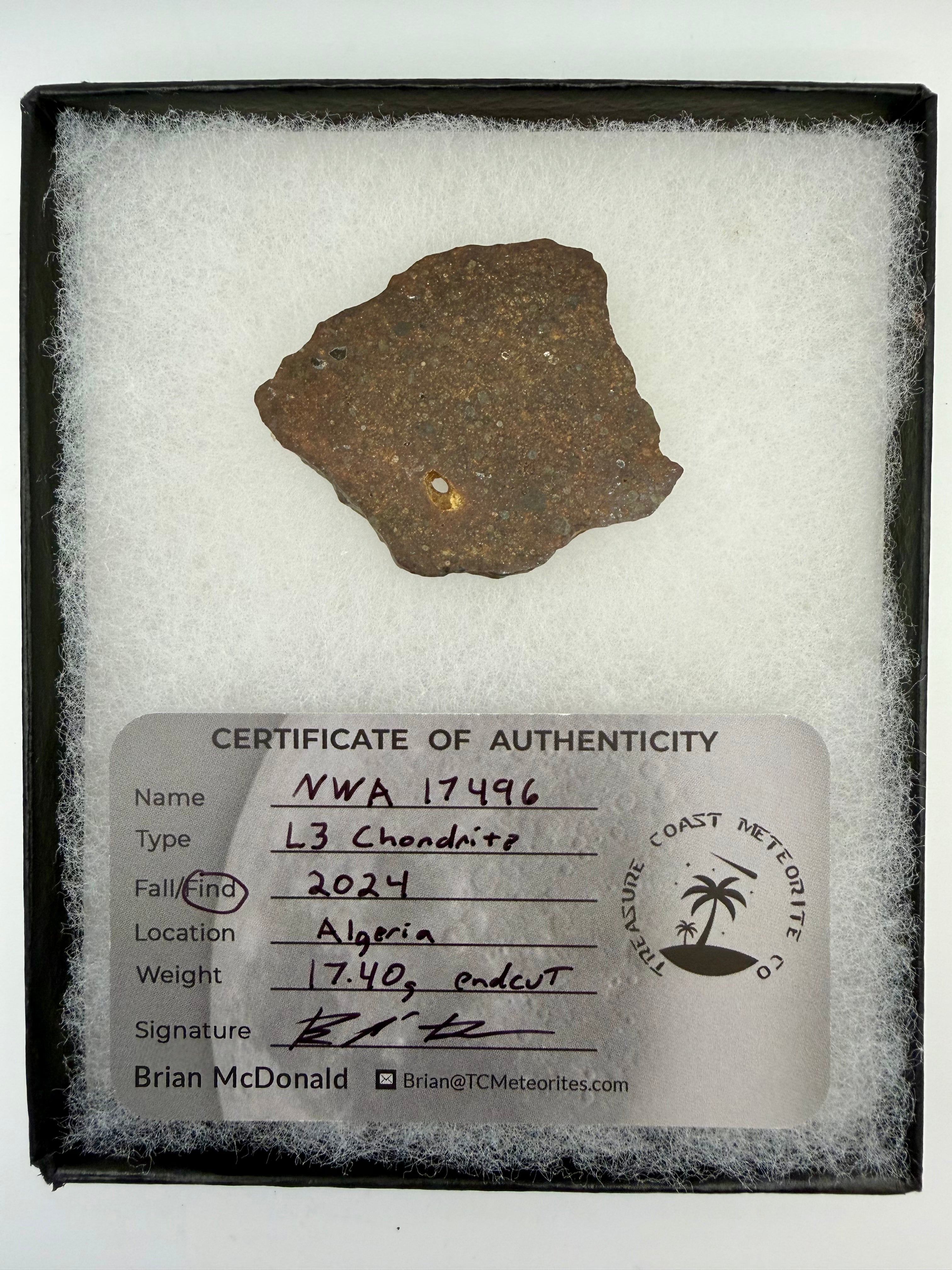


NWA 17496 Chondrite Meteorite End Cut, L3, 17.40g, Preserved Chondrules in Riker Display
Meteorite Details
Meteorite Name: NWA 17496
Subtype: Stony
Classification: L3 Ordinary Chondrite
Weight: 17.4 g
Year Found: 2024
Fall / Find: Find
Location: Algeria

$60.00 USD
Sale price
$60.00 USD
Regular price
Primitive solar system building blocks on display
This 17.40g polished end cut exposes the internal structure of NWA 17496, a Type 3 ordinary chondrite classified in 2024. The polished surface reveals spherical chondrules, submillimeter droplets of once-molten silicate that condensed in the solar nebula 4.567 billion years ago. Type 3 specimens retain their original textures with minimal thermal alteration, making chondrule boundaries distinct and their internal structures visible. The cut preserves the contrast between these spherical components and the fine-grained matrix surrounding them.
The specimen arrives in a professional riker display case with foam backing and clear lid, ready for shelf display or educational demonstration. The case protects the polished surface while keeping structural features visible without handling.
Structure and features
The L3 classification denotes a low total iron content (19-22% by mass) compared to other ordinary chondrite groups, with approximately 7-11% metallic iron-nickel distributed throughout. As an unequilibrated Type 3 specimen, this meteorite shows compositional variation between individual chondrules, each preserves its formation chemistry rather than homogenizing through parent body heating. The polished surface exposes chondrule margins where olivine and pyroxene grains meet the darker, finer matrix. Metal grains appear as bright flecks scattered through the section.
End cuts like this one section the meteorite perpendicular to any natural face, revealing internal structure rather than weathered exterior. The polish grade brings out textural detail while maintaining scientific integrity, the slice remains thick enough to show three-dimensional chondrule distribution rather than presenting only a thin section view.
Scientific context
Ordinary chondrites constitute approximately 87% of all meteorite falls and represent material from numerous parent asteroids in the main belt between Mars and Jupiter. The L group, distinguished by lower iron content than H chondrites but higher than LL types, likely derives from several related parent bodies disrupted by collisions over solar system history. Type 3 classification indicates peak metamorphic temperatures remained below 600°C, insufficient to erase original chondrule textures or equilibrate mineral compositions.
NWA 17496 was recovered in Algeria and classified in 2024, adding to the scientific dataset for L3 chondrites. These specimens preserve records of processes that occurred in the solar nebula before planets formed, when dust and droplets collided and accreted into larger bodies. The visible chondrules formed through rapid cooling of silicate melt droplets, likely during energetic events in the protoplanetary disk. For comprehensive background on meteorite classification and how scientists identify different types, see Learn About Meteorites.
Frequently asked questions
Is this meteorite authenticated? Yes. NWA 17496 is classified in the Meteoritical Bulletin as an L3 ordinary chondrite. You can verify the classification through the Meteoritical Bulletin database. Each specimen includes a certificate of authenticity documenting its classification, weight, and recovery details.
What does Type 3 mean for chondrites? Type 3 indicates minimal thermal metamorphism on the parent asteroid. Chondrules retain their original boundaries and internal structures rather than recrystallizing into uniform texture. Type 3 chondrites are considered primitive because they preserve features from the earliest solar system, before parent body heating altered mineral compositions.
What is included with this specimen? You receive the 17.40g polished end cut, professional riker display case with foam backing and clear viewing lid, and certificate of authenticity. No stand is included, the riker case is designed for shelf or table display.
How should I display this specimen? The riker case protects the polished surface from dust and handling while allowing clear viewing. Place the case on a flat surface away from direct sunlight to prevent foam degradation. The case can be opened to examine the specimen more closely, but avoid touching the polished face to prevent fingerprints on the surface.
What is the difference between L, H, and LL chondrites? The letters denote total iron content and the amount present as metal versus bound in silicates. H (high iron) chondrites contain 25-31% total iron, L (low iron) contain 19-22%, and LL (low iron, low metal) contain 19-22% total iron but less free metal. These groups likely formed on separate parent asteroids with different oxidation states during accretion.
Collector significance
Type 3 ordinary chondrites appeal to collectors seeking specimens that show visible internal structure without magnification. The 17.40g size provides substantial display presence while remaining accessible for new collectors building reference collections. The riker case format eliminates the need for additional display materials and protects the specimen from handling damage. Collectors building systematic representations of meteorite types value L group specimens as examples of moderate iron content between the more metal-rich H chondrites and metal-poor LL types.
The 2024 classification date makes this a recent addition to the Meteoritical Bulletin, representing freshly classified material rather than older stock. The polished end cut format serves both aesthetic and educational purposes, the internal structure teaches solar system formation processes while the presentation quality suits shelf display. For collectors focused on primitive solar system materials, explore our complete selection of Chondrites.
Meteoritical Bulletin entry: NWA 17496 | Classification: L3 Ordinary Chondrite | Find, Algeria, 2024