

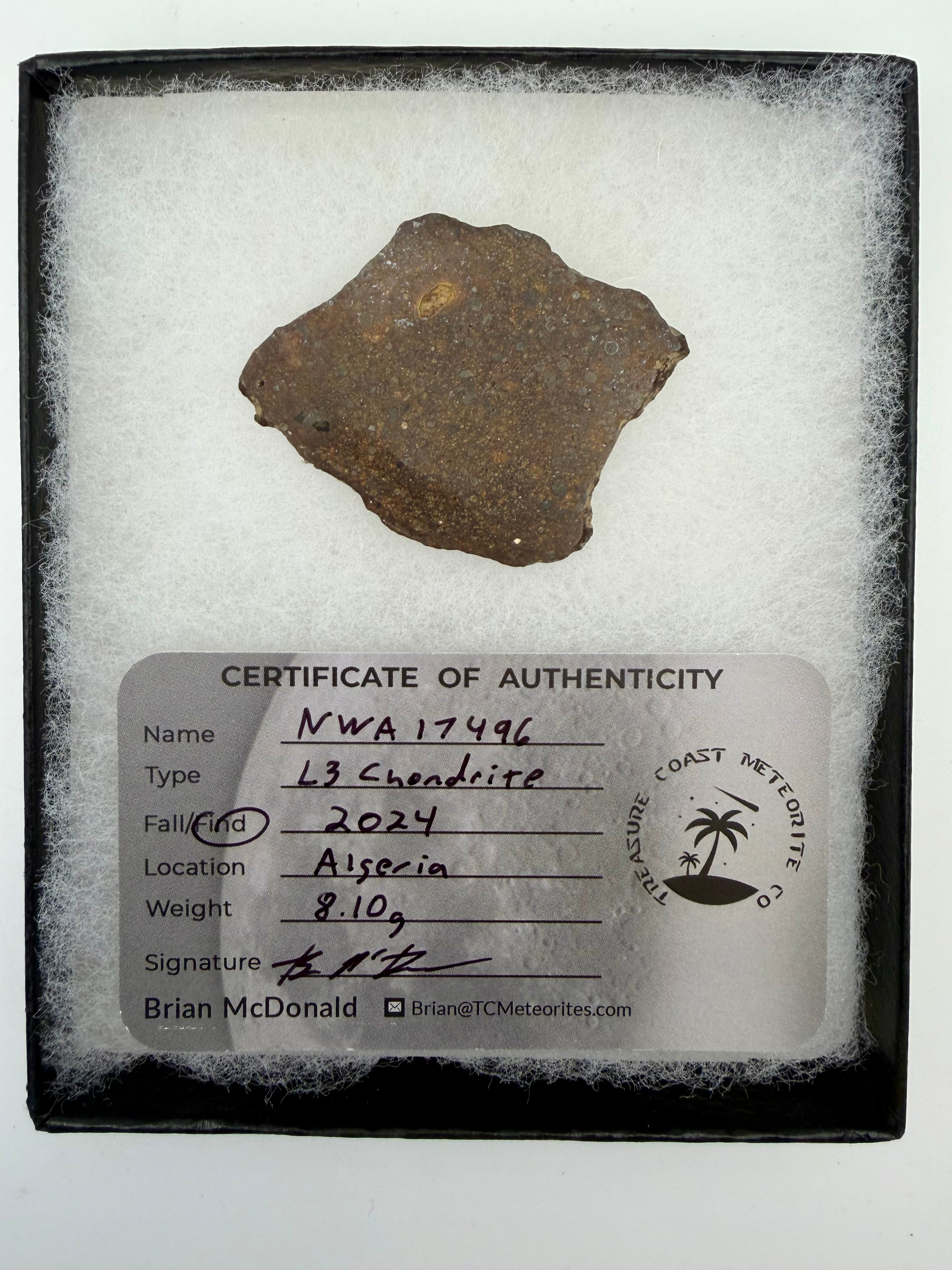
NWA 17496 Ordinary Chondrite Meteorite Slice, L3, 8.10g, Preserved Chondrules in Riker Display
$40.00 USD
Sale price
$40.00 USD
Regular price
Skip to product information


NWA 17496 Ordinary Chondrite Meteorite Slice, L3, 8.10g, Preserved Chondrules in Riker Display
Meteorite Details
Meteorite Name: NWA 17496
Subtype: Stony
Classification: L3 Ordinary Chondrite
Weight: 8.1 g
Year Found: 2024
Fall / Find: Find
Location: Algeria

$40.00 USD
Sale price
$40.00 USD
Regular price
Primitive solar system material in display-ready presentation
This 8.10g slice of NWA 17496 preserves the unequilibrated texture characteristic of Type 3 chondrites. The polished face reveals individual chondrules suspended in a matrix that retains the chemical and mineralogical diversity present when this rock formed 4.6 billion years ago. The specimen arrives in a professional riker display case with foam backing and clear lid, ready for immediate display or study. The L group designation indicates moderate iron content relative to other ordinary chondrites, while the Type 3 classification confirms minimal thermal alteration since accretion in the early solar nebula.
The slice format provides access to the internal structure while the riker case protects the specimen from handling and atmospheric exposure. This combination suits collectors seeking displayable specimens and educators demonstrating chondrite classification to students.
Chondrule preservation and matrix structure
Type 3 chondrites retain clearly defined boundaries between chondrules and matrix, unlike their more thermally processed Type 4-6 counterparts where these features blur or disappear entirely. Individual chondrules in this specimen show the spherical to sub-spherical forms created by flash heating events in the solar nebula. The polished surface allows direct observation of these structures without magnification, though additional detail emerges under loupe examination.
The matrix surrounding the chondrules contains fine-grained silicate minerals, metal grains, and sulfides in their original spatial relationships. This preservation provides a record of conditions in the asteroid belt before planetary differentiation began.
Scientific context
L ordinary chondrites represent approximately 38% of observed meteorite falls, making them the second most common chondrite group after H types. The moderate iron content distinguishes them chemically from the high-iron H group and low-iron LL group. NWA 17496 belongs to the primitive end of the metamorphic sequence where original nebular materials remain largely unaltered by parent body processes.
The Type 3 classification indicates peak metamorphic temperatures below 400°C on the parent asteroid, insufficient to homogenize mineral compositions or erase chondrule boundaries. This preservation allows researchers to study the raw materials that accreted to form asteroids and, eventually, planets. The specimen documents conditions in the region of the solar nebula where ordinary chondrite parent bodies formed, approximately 2-3 AU from the proto-Sun. Learn About Meteorites provides additional context on chondrite formation and classification systems.
Frequently asked questions
Is this meteorite authenticated? NWA 17496 is classified in the Meteoritical Bulletin as an L3 ordinary chondrite. View the official entry: NWA 17496. Each specimen includes a certificate of authenticity documenting the classification and provenance.
What does Type 3 mean in chondrite classification? Type 3 indicates the lowest degree of thermal metamorphism in the petrologic type scale (3-6). These specimens preserve original chondrule textures, distinct mineral boundaries, and unequilibrated chemistry from the solar nebula. Higher types show progressively more thermal alteration and homogenization.
What is included with this specimen? The 8.10g slice arrives mounted in a professional riker display case with protective foam backing and clear viewing lid. A certificate of authenticity documents the classification and specimen details.
How should I display this specimen? The riker case provides complete display protection and requires no additional mounting. Position away from direct sunlight to prevent foam degradation. The case dimensions allow vertical or horizontal display on shelving or in cabinets.
What makes L chondrites different from H and LL types? The L (low iron) designation indicates total iron content of 20-25% by mass, intermediate between H group (25-31%) and LL group (19-22%). This chemical distinction reflects formation in different regions of the asteroid belt with varying metal abundances in the local nebula.
Type 3 chondrites in meteorite collections
Primitive chondrites serve as baseline specimens in systematic collections, representing the least-processed materials available from the early solar system. The 8.10g mass provides sufficient size for clear chondrule observation while remaining accessible to collectors building comprehensive ordinary chondrite suites. The riker presentation eliminates the need for separate mounting or display cases.
The 2024 recovery date indicates recent availability on the market, with classification completed through standard Meteoritical Society protocols. Algeria continues to produce significant numbers of meteorite finds due to favorable preservation conditions in the Sahara, though each specimen undergoes individual classification rather than provisional grouping. Collectors seeking Chondrites or Budget Friendly Pieces will find this specimen meets both display and study requirements without premium pricing.
Meteoritical Bulletin entry: NWA 17496 | Classification: L3 Ordinary Chondrite | Find, Algeria, 2024