

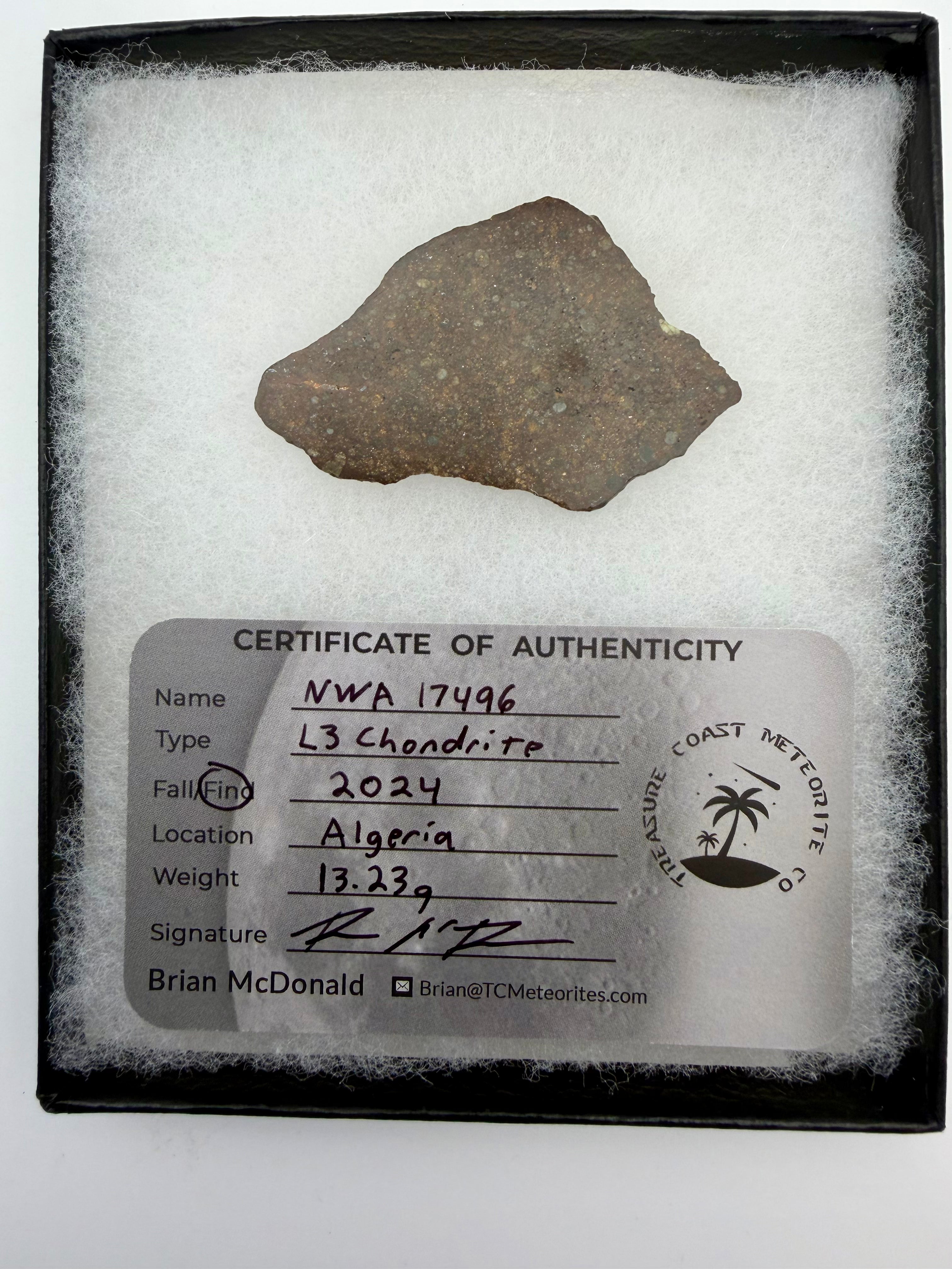
NWA 17496 Chondrite Meteorite Slice, L3, 13.23g, Preserved Chondrules in Riker Display
$55.00 USD
Sale price
$55.00 USD
Regular price
Skip to product information


NWA 17496 Chondrite Meteorite Slice, L3, 13.23g, Preserved Chondrules in Riker Display
Meteorite Details
Meteorite Name: NWA 17496
Subtype: Stony
Classification: L3 Ordinary Chondrite
Weight: 13.23 g
Year Found: 2024
Fall / Find: Find
Location: Algeria

$55.00 USD
Sale price
$55.00 USD
Regular price
Primitive chondrules frozen in time
This 13.23g polished slice reveals the pristine internal structure of NWA 17496, a Type 3 ordinary chondrite recovered from Algeria in 2024. The polished surface exposes individual chondrules--spherical grains that formed as molten droplets in the solar nebula 4.6 billion years ago. Type 3 meteorites preserve these features in their original state, unaltered by the thermal metamorphism that obscures chondrules in more equilibrated specimens. The slice captures this primitive texture across its entire face, with metal flecks distributed throughout the silicate matrix.
The specimen arrives ready for display in a professional riker case with foam backing, protecting the polished surface while allowing clear viewing of the chondrule population. The transparent lid keeps dust away while maintaining visibility from all angles.
Chondrule structure and matrix composition
The polished face shows distinct chondrules ranging from submillimeter to several millimeters in diameter, each preserving its original spherical or ellipsoidal geometry. These structures formed through rapid cooling of molten silicate droplets in the protoplanetary disk, flash-frozen before they could crystallize into uniform minerals. The surrounding matrix contains fine-grained olivine and pyroxene in unequilibrated proportions--meaning individual mineral grains retain compositional variations rather than homogenizing through heat.
Metal grains appear as bright flecks throughout the section, characteristic of L chondrites which contain lower total iron than H chondrites but still host abundant kamacite and taenite. The polish brings out the contrast between metal, chondrules, and matrix, making the meteorite's internal architecture immediately visible.
Scientific context
L ordinary chondrites represent the second most common type of meteorite fall, accounting for roughly 35% of all observed meteorite falls worldwide. The "L" designation refers to low total iron content relative to H chondrites, typically 7-11% metallic iron by mass. These meteorites derive from parent body or bodies in the main asteroid belt that never underwent the internal heating required to melt and differentiate into core-mantle structures.
Type 3 classification marks this specimen as petrologic grade 3, the most primitive category that still qualifies as a true chondrite. At this grade, chondrules remain sharply defined with glassy mesostasis, and the matrix has experienced minimal recrystallization. Types 4-6 show progressive thermal metamorphism that gradually erases original textures. NWA 17496's Type 3 status means its chondrules preserve formation conditions from the earliest epoch of solar system history. Meteoritical Bulletin classification confirms this specimen's authenticity and petrologic grade.
Frequently asked questions
Is this meteorite authenticated? Yes. NWA 17496 is classified in the Meteoritical Bulletin as an L3 ordinary chondrite from Algeria, found in 2024. Full classification data: NWA 17496. This specimen includes a certificate of authenticity documenting its classification and weight.
What does Type 3 mean? Type 3 is the petrologic grade indicating minimal thermal alteration. Chondrules retain their original sharp boundaries and glassy interiors, and minerals remain unequilibrated--they haven't homogenized through heat. This makes Type 3 chondrites the most primitive specimens available to collectors, preserving solar nebula formation conditions.
What is included with this specimen? The 13.23g slice, professional riker display case with foam backing and transparent lid, and certificate of authenticity.
Why are chondrules scientifically important? Chondrules are the oldest known solid materials in the solar system, formed during the first few million years of disk evolution. Their textures record cooling rates, nebular temperatures, and the physics of dust aggregation. Type 3 chondrites like this preserve chondrule populations in near-pristine condition, making them windows into conditions that no longer exist anywhere in the solar system.
How should I display this specimen? The included riker case is designed for shelf or cabinet display. Keep it away from direct sunlight to prevent potential fading of the foam backing. The transparent lid protects the polished surface from dust and handling while maintaining full visibility. No additional preparation is required.
Ready-to-display primitive material
This slice requires no additional mounting or preparation. The riker case provides immediate display capability for home collections, classroom demonstrations, or office shelving. At 13.23g, the specimen offers substantive size while remaining accessible to collectors building type collections or focusing on primitive chondrites.
L3 chondrites occupy a specific niche in systematic collections: common enough to be obtainable, primitive enough to show textbook chondrule structure, and visually distinct from more metamorphosed grades. This specimen fits into chondrite collections focused on petrologic diversity or unequilibrated specimens. The 2024 recovery date marks it as recently classified material entering the market.
Classification reference
Meteoritical Bulletin entry: NWA 17496 | Classification: L3 Ordinary Chondrite | Find, Algeria, 2024