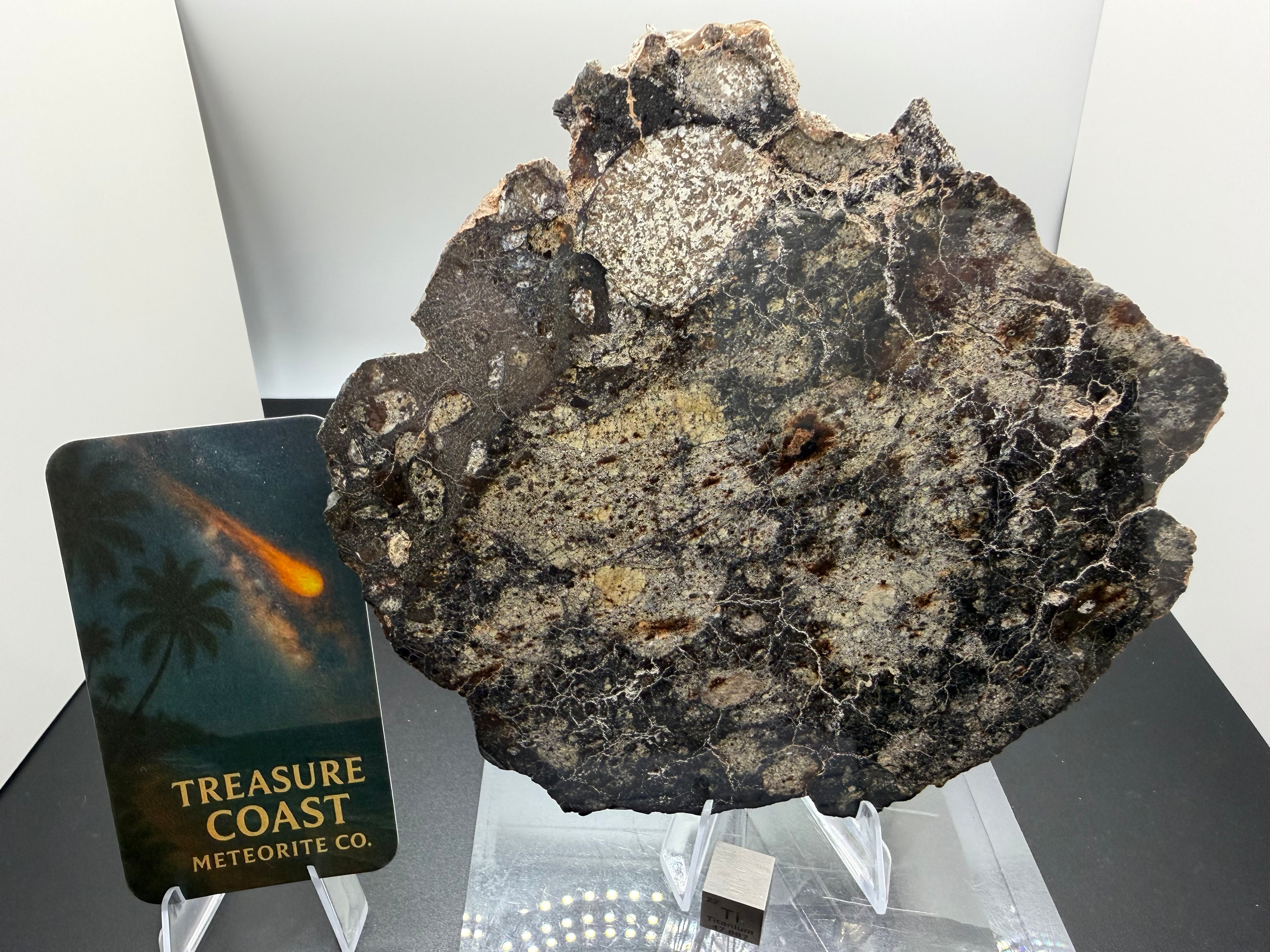
Stony Meteorites
Stony meteorites are silicate-rich rocks that include both primitive chondrites and differentiated achondrites.

Stony meteorites are silicate-rich rocks that include both primitive chondrites and differentiated achondrites.
Stony meteorites are the most common type, accounting for over 90 percent of all observed meteorite falls. This category spans the full range from primitive chondrites preserving 4.56 billion year old solar nebula material to achondrites from the crusts of differentiated asteroids, the Moon, and Mars. Unless specifically stated in the listing, specimens in this collection are Meteoritical Bulletin classified.
Every specimen in this collection is tied to a Meteoritical Bulletin entry, the official global registry of classified meteorites maintained by the Meteoritical Society. Classification is performed by accredited laboratories that analyze mineralogy, oxygen isotope ratios, and chondrule textures. Visual inspection alone is unreliable because many terrestrial rocks superficially resemble stony meteorites. The Bulletin record is the definitive confirmation of authenticity. Read more: The Meteoritical Bulletin Explained.
Chondrites are the most primitive meteorites known. Their parent asteroids never melted, preserving the original composition of the early solar system. Most contain chondrules, tiny spherical objects that formed when molten droplets rapidly cooled in the solar nebula 4.56 billion years ago. Ordinary chondrites (H, L, LL groups) are the most commonly recovered meteorites on Earth. Carbonaceous chondrites contain water bearing minerals, organic compounds, and presolar grains older than the Sun itself. Read more: What Is a Chondrite?
Achondrites are stony meteorites from parent bodies that did melt and differentiate, separating into core, mantle, and crust. They include the HED clan (howardites, eucrites, and diogenites from asteroid 4 Vesta), lunar meteorites, Martian meteorites, and rare ungrouped achondrites from unidentified parent bodies. Read more: What Is an Achondrite?
How can I tell a stony meteorite from a terrestrial rock? Look for a dark fusion crust from atmospheric entry, density higher than typical Earth rocks, and metallic flecks visible on a cut surface in most chondrites. Definitive identification requires laboratory analysis and a Bulletin entry. Read more: How Can You Tell if a Meteorite Is Real?
Are stony meteorites magnetic? Most chondrites contain enough metallic iron and nickel to attract a magnet, though usually weaker than iron meteorites. Many achondrites contain very little metal and may not be magnetic at all. Magnetism alone does not confirm a meteorite. Read more: Are Meteorites Magnetic?
What is fusion crust? Fusion crust is the thin, dark, glassy outer layer that forms when a meteorite's surface melts during atmospheric entry. It is one of the most reliable visual indicators of a genuine meteorite. Read more: What Is Fusion Crust on a Meteorite?
How do I tell a stony meteorite from slag? Industrial slag often looks superficially meteoritic but is typically full of bubbles (vesicles), has a glassy appearance throughout, and lacks chondrules or true fusion crust. Read more: Meteorite vs Slag: How to Tell the Difference
Are these specimens authenticated? Unless otherwise noted, every stony meteorite here has a Meteoritical Bulletin record and ships with a Treasure Coast Meteorite Co. certificate of authenticity.
See also: Chondrites · Carbonaceous Chondrites · HED Meteorites · Lunar Meteorites · Martian Meteorites · Types of Meteorites · Are Meteorites Illegal to Own?