
Learn · Meteorite Identification
A meteorite is a rock from another world. A tektite is a piece of Earth that was melted by a meteorite impact and thrown hundreds or thousands of kilometers before it cooled into glass. Both owe their existence to something arriving from space, which is why they are so often confused. Only one of them came from space.
The short answer
Tektites, moldavite, Libyan Desert Glass, Darwin glass and other impact glasses are not meteorites. They are terrestrial rock, melted by the energy of a large impact. The object that struck was a meteoroid or asteroid, but almost none of it survives in the glass. What you hold is Earth.
The scientific definition used in meteoritics settles the question. Rubin and Grossman (2010) define a meteorite as a natural solid object derived from a celestial body, carried by natural means out of that body's dominant gravitational influence, which later collided with another body. A tektite is launched from Earth and falls back to Earth without ever leaving Earth's gravity, so it does not qualify.
Meteorite and tektite compared
One practical caution: meteorites themselves are not always magnetic, and not every dark, heavy rock is a meteorite. For the field checks that do and do not work, see how can you tell if a meteorite is real and I think I found a meteorite, now what.
Tektite, impact glass, impactite: the terms
Impactite is the broad term for any rock created or altered by an impact. It covers impact breccias such as suevite, impact melt rock, and impact glass.
Impact glass is glass formed from target rock melted by an impact. Most of it is found in or near the crater, or across a limited area around the melting site.
Tektites are a specific kind of impact glass. They are distal ejecta: melted surface rock thrown far from the crater, cooled in flight, and found across wide areas called strewn fields. They are chemically consistent within each field, extremely dry, and carry only a very small extraterrestrial component (Koeberl et al. 2022).
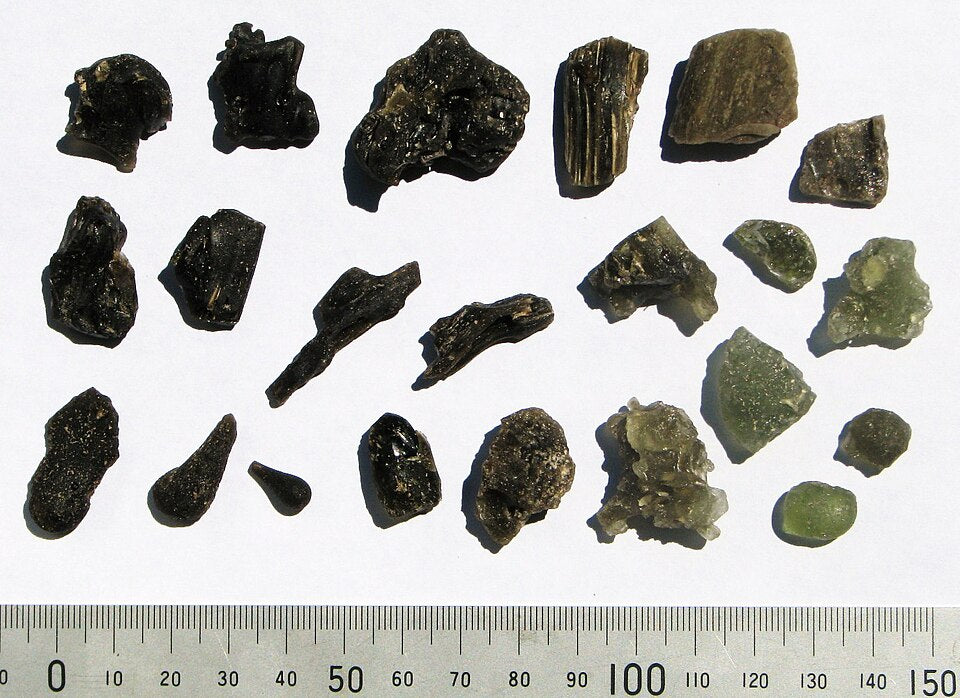
By these definitions, moldavite and australites are tektites. Darwin glass is impact glass found around its probable source crater, and Libyan Desert Glass is generally described as impact glass rather than a true tektite. Collectors often lump all of them together as "tektites," and dealers do too. The distinction is worth knowing because it tells you how far the material traveled and how it formed.
The known tektite strewn fields
For decades the literature recognized four tektite strewn fields. A fifth was proposed in 2021. Three of the four classic fields are firmly tied to a known source crater; the largest is not.
| Strewn field | Tektites | Age | Source crater |
|---|---|---|---|
| Australasian | Australites, indochinites, philippinites, Muong Nong type | ~790,000 yr | Not confirmed. Bolaven Plateau, Laos, proposed (Sieh et al. 2020) and disputed |
| Central European | Moldavites | ~14.8 Myr | Ries crater, Germany |
| Ivory Coast | Ivorites | ~1.07 Myr | Bosumtwi crater, Ghana |
| North American | Bediasites, georgiaites | ~35 Myr | Chesapeake Bay impact structure, Virginia |
| Belize (proposed, 2021) | Belizites | ~804,000 yr | Pantasma crater, Nicaragua (Rochette et al. 2021) |
Ages are rounded from the studies cited in the research section below. The Australasian field is the youngest and largest of the classic four, extending across roughly a tenth of Earth's surface (Melosh 2020).
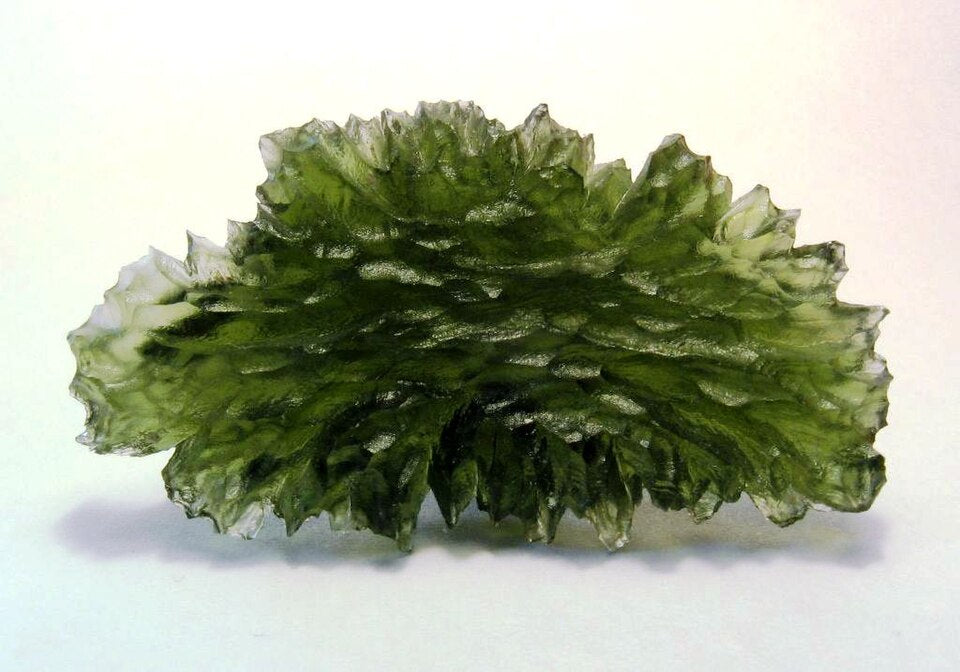
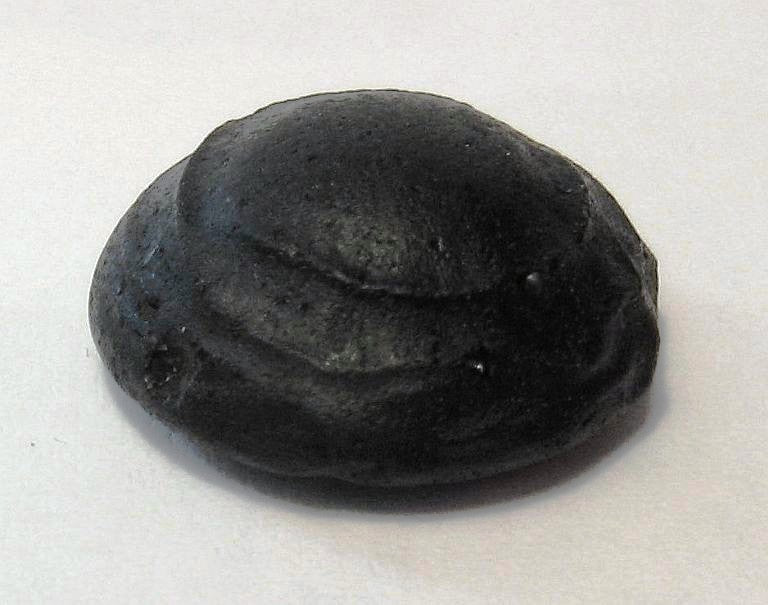
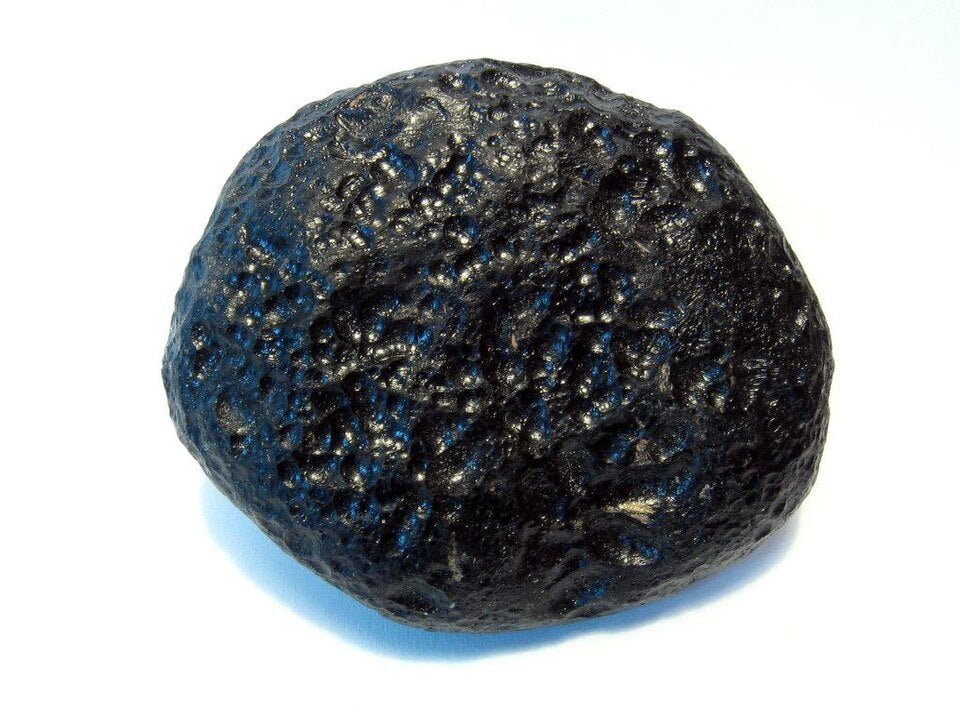
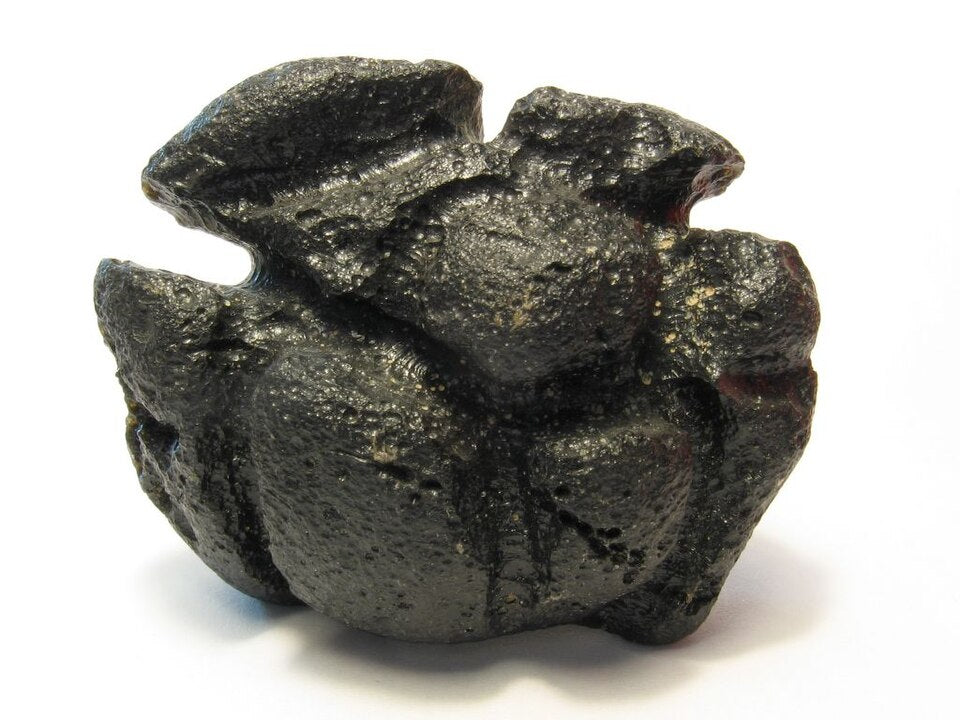
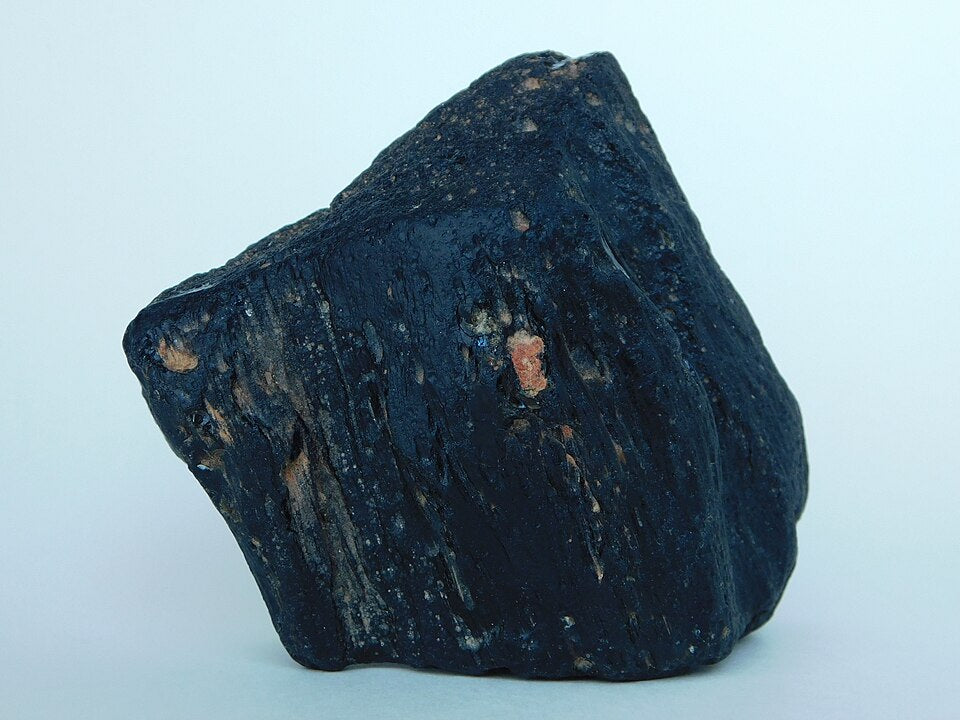
Two impact glasses collectors ask about
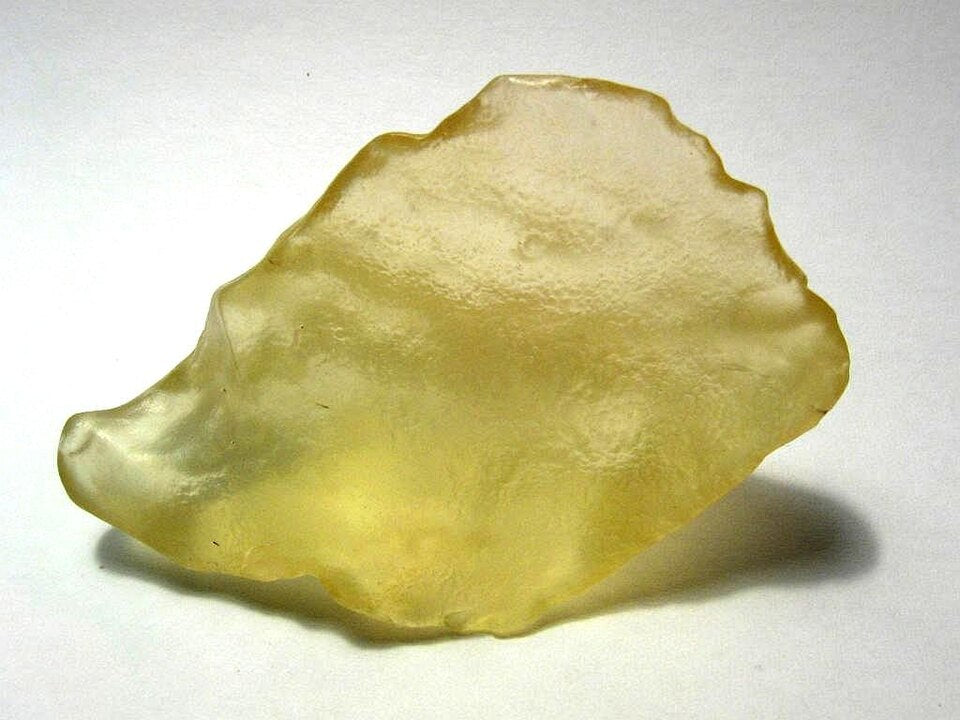
Libyan Desert Glass is nearly pure silica glass, yellow to green and often translucent, found across thousands of square kilometers of the Great Sand Sea in western Egypt near the Libyan border. Despite the name, the field lies in Egypt. It formed about 29 million years ago. Its source crater has never been identified, and whether it formed in a ground impact or a very large airburst was debated for decades. The research section covers that debate in full.
Darwin glass is impact glass from western Tasmania, found over about 400 square kilometers around Darwin Crater, a 1.2 km structure that is the probable but unconfirmed source. It is dated to about 816,000 years ago (Lo et al. 2002).
The story
Impact glass has been collected far longer than meteorites have been understood.
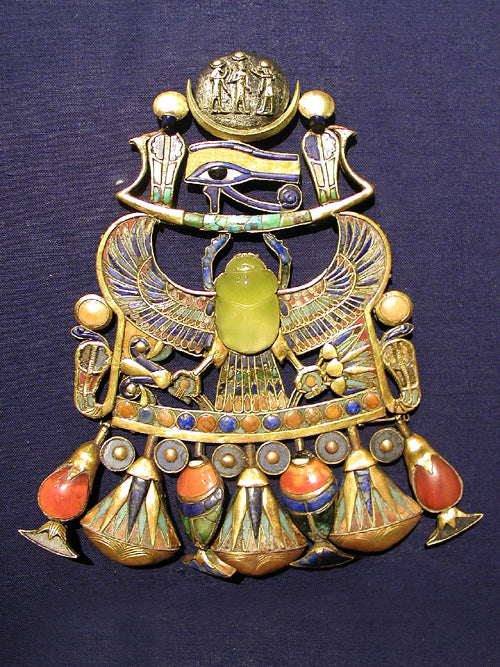
A pharaoh's scarab. One of the pectorals found by Howard Carter in the tomb of Tutankhamun in 1922 has a scarab carved from greenish yellow glass at its center. It was taken to be chalcedony until 1998, when it was identified as Libyan Desert Glass. The glass field itself had been mentioned in 1850 by the French consul Fulgence Fresnel, and was explored scientifically by Patrick Clayton's expedition in 1932 (Simon 2025).
Moldavite in the Stone Age. Moldavites have been recovered at Willendorf, the Austrian site of the Venus of Willendorf, suggesting that people tens of thousands of years ago were already collecting this green glass (Melosh 2020, a commentary that mentions the association in passing).
Darwin glass in Tasmania. Tasmanian Aboriginal people found and traded Darwin glass thousands of years before Europeans recorded it in the mid nineteenth century, according to Lo and colleagues, citing Storey (1987), in a National Taiwan University project report on their Darwin glass dating.
Sources: Simon, R. (2025), The curious history of Tutankhamun's scarab, Aegyptus et Pannonia IX, pp. 205 to 266. Melosh (2020) as cited below.
What the research reports
Tektites are not meteorites, so the Meteoritical Bulletin has no classification to quote. The research below comes from peer-reviewed journals and, where labeled, conference abstracts. Findings come from the authors' own samples and methods and are given as the studies state them. Where studies disagree, both sides are presented.
Tektites are melted Earth rock
Koeberl, C. (1992). Tektite origin by hypervelocity asteroidal or cometary impact: The quest for the source craters. Conference abstract, NASA Technical Reports Server. Koeberl summarizes the consensus that tektites formed by melting and quenching of terrestrial rocks in a hypervelocity impact, and that their chemistry matches upper continental crust. He also describes the aerodynamic ablation of australites, which partially remelted as they re-entered the atmosphere after being ejected beyond it.
For much of the twentieth century a lunar origin was argued seriously, most prominently by NASA's John O'Keefe. Geochemical and isotopic work has since tied tektite compositions to terrestrial source rocks, and the lunar hypothesis is no longer held in the field.
Water content separates tektites from volcanic glass
Beran, A. and Koeberl, C. (1997). Water in tektites and impact glasses by Fourier-transformed infrared spectrometry. Meteoritics and Planetary Science 32, 211 to 216. Measuring 26 tektites from all four classic strewn fields, they found water contents of 0.002 to 0.030 weight percent, with Ivory Coast tektites the driest. Impact glasses ran slightly wetter; Libyan Desert Glass came in around 0.11 weight percent. Both kinds of glass are far drier than volcanic glass, which the authors treat as good evidence of an impact origin.
Moldavites and the Ries crater
Schmieder, M., Kennedy, T., Jourdan, F., Buchner, E. and Reimold, W.U. (2018). A high-precision 40Ar/39Ar age for the Nordlinger Ries impact crater, Germany, and implications for the accurate dating of terrestrial impact events. Geochimica et Cosmochimica Acta 220, 146 to 157. Argon-argon dating of moldavites gave a weighted mean age of 14.808 million years, with an uncertainty of 0.038 million years including all external errors, which the authors take as the age of the Ries impact.
The date was challenged. Rocholl and colleagues (2018, comment in Geochimica et Cosmochimica Acta) argued that paleomagnetic evidence allows only impact ages of about 14.87 or 14.61 million years. Schmieder and colleagues replied in the same journal (volume 238, pages 602 to 605) that their age agrees with the recalibrated time scale and questioned the paleomagnetic constraint. All parties agree on roughly 14.6 to 14.9 million years; the dispute is over which hundred thousand years.
The missing Australasian crater
Sieh, K. and colleagues (2020). Australasian impact crater buried under the Bolaven volcanic field, Southern Laos. PNAS 117, 1346 to 1353. The authors present four lines of evidence that the source crater lies beneath younger lava flows of the Bolaven Plateau: tektite chemistry, argon dates on lavas above and around the site, a gravity anomaly consistent with a buried crater of roughly 17 by 13 km, and a breccia outcrop they interpret as proximal ejecta. A follow-up (Sieh et al. 2023, PNAS 120) described that breccia in detail and dated the tektite-forming impact to about 789,000 years ago.
In an accompanying commentary, H.J. Melosh (2020, PNAS 117) called Bolaven the best candidate yet, while noting that not everyone was convinced and that drilling would be needed to prove it. Mizera (2022, Meteoritics and Planetary Science 57) rejected the proposal, arguing that a sandstone and basalt mixture is geochemically unsuitable as the tektite source, and Mizera and Strunga (2024, PNAS 121) disputed the proposed ejecta; Sieh and colleagues replied in the same issue that the ejecta deposit essentially settles the case. Mizera and colleagues have instead proposed the Alashan Desert of northwest China. As of November 2026 no Australasian source crater has been confirmed.
Bosumtwi and the Ivory Coast tektites
Koeberl, C. and colleagues (1998). Petrology and geochemistry of target rocks from the Bosumtwi impact structure, Ghana, and comparison with Ivory Coast tektites. Geochimica et Cosmochimica Acta 62, 2179 to 2196. The study found that the composition of the Ivory Coast tektites can be reproduced from a mixture of the crater's local rocks. Together with matching ages, this ties the tektites to the 10.5 km, 1.07 million year old Bosumtwi crater. Osmium isotope work by Koeberl and Shirey (1993), as summarized in the Bosumtwi drilling project overview (Koeberl et al. 2007), detected a small meteoritic component in the tektites.
Chesapeake Bay and the North American tektites
Deutsch, A. and Koeberl, C. (2006). Establishing the link between the Chesapeake Bay impact structure and the North American tektite strewn field: The Sr-Nd isotopic evidence. Meteoritics and Planetary Science 41, 689 to 703. Strontium and neodymium isotopes in bediasites matched the Chesapeake Bay target rocks and excluded Russia's Popigai crater, which has an age within error of the tektites. The authors concluded Chesapeake Bay is clearly the source crater.
A proposed fifth strewn field in Belize
Rochette, P. and colleagues (2021). Impact glasses from Belize represent tektites from the Pleistocene Pantasma impact crater in Nicaragua. Communications Earth and Environment 2, 94. Glasses found in Belize share an age of about 804,000 years and consistent chemistry and isotopes with the 14 km Pantasma crater, 530 km away. The authors propose them as a previously unrecognized tektite strewn field.
Koeberl and colleagues (2022, Geochimica et Cosmochimica Acta) studied 18 Belize glasses and confirmed an impact origin from their petrography and low water content. They found the chemistry typical of Central American volcanic arc rocks and clearly different from the Australasian tektites.
Libyan Desert Glass: impact or airburst
For decades the leading alternative to a ground impact was a very large, low altitude airburst. Boslough and Crawford (2008, International Journal of Impact Engineering 35) used numerical simulations to show that a large airburst could melt surface material, and proposed Libyan Desert Glass and the layered Muong Nong tektites as possible examples. Kramers and colleagues (2013, Earth and Planetary Science Letters 382) described "Hypatia," an unusual diamond-bearing stone from the glass field, and suggested it may be a fragment of a comet whose airburst formed the glass.
Cavosie, A.J. and Koeberl, C. (2019). Overestimation of threat from 100 Mt-class airbursts? High-pressure evidence from zircon in Libyan Desert Glass. Geology 47, 609 to 612. Zircon grains in all seven samples studied preserved crystal orientations that form only on reversion from reidite, a high-pressure mineral that requires shock pressures of about 30 GPa. Airbursts do not generate shock of that kind at the ground. The authors conclude a crater-forming impact was involved.
The source crater is still unknown. El-Baz and Ghoneim (2007, International Journal of Remote Sensing 28) identified the 31 km Kebira structure on the Egypt and Libya border from satellite data and suggested it as the source. It has not been confirmed as an impact structure by field study. Longinelli and colleagues (2011, Meteoritics and Planetary Science 46) found that oxygen isotopes of sandstone from the Kebira area differ strongly from the glass and ruled that sandstone out as the source material. Sighinolfi and colleagues (2020, Meteoritics and Planetary Science) pointed instead to weathering products of sandstones that include Gilf Kebir rocks as the most likely melted material. The melting site remains an open question.
Darwin glass
Lo, C.H., Howard, K.T., Chung, S.L. and Meffre, S. (2002). Laser fusion argon-40/argon-39 ages of Darwin impact glass. Meteoritics and Planetary Science 37, 1555 to 1562. They dated Darwin glass to a weighted mean of 816,000 years, statistically indistinguishable from the Australasian tektites. Because of differences in composition and texture, and its distance from the presumed Australasian source area, they consider a separate impact during the same period more likely.
Definitions and densities
Rubin, A.E. and Grossman, J.N. (2010). Meteorite and meteoroid: New comprehensive definitions. Meteoritics and Planetary Science 45, 117 to 125. Source of the definition of meteorite used at the top of this page.
Britt, D.T. and Consolmagno, G.J. (2003). Stony meteorite porosities and densities: A review of the data through 2001. Meteoritics and Planetary Science 38, 1161 to 1180. Compiling 925 samples of 454 meteorites, they found most stony meteorites have densities of about 3 to 4 g/cm3, lower only for some volatile-rich carbonaceous meteorites and higher for stony irons.
Buying tektites and impact glass
Because tektites have no Meteoritical Bulletin entry, the record that protects you is locality and a seller who describes the material correctly. A few points worth applying to any listing:
- The listing should call it a tektite, impact glass or impactite, never a meteorite.
- The type should match its strewn field. Moldavite comes from the Central European field, centered on southern Bohemia and Moravia in the Czech Republic. Libyan Desert Glass comes from western Egypt.
- Manufactured green glass is sold as moldavite in the gem and crystal trade. Buy from a seller who states the locality and will stand behind it.
- Claims about energy, healing or extraterrestrial power are marketing, not mineralogy.
Treasure Coast Meteorite Co. lists tektites and impact glass in their own collection, separate from meteorites, and describes them as terrestrial impact material. Our standards for authenticity are set out on the authenticity and certificates page.
Frequently asked questions
- Is a tektite a meteorite?
- No. A tektite is natural glass made from Earth's own surface rock, melted by the impact of a large meteoroid or asteroid and thrown across a wide area before it cooled. A meteorite is a rock that came from another body, such as an asteroid, the Moon or Mars. Tektites are related to meteorites by cause, not by origin.
- Is moldavite a meteorite?
- No. Moldavite is a tektite from the Central European strewn field, formed when an impact created the Ries crater in southern Germany about 14.8 million years ago. Molten rock was thrown east and landed mainly in what is now the Czech Republic. It is melted Earth rock, not material from space.
- Is Libyan Desert Glass a meteorite or a tektite?
- Neither, strictly. Libyan Desert Glass is an impact glass: nearly pure silica glass formed about 29 million years ago when surface material in what is now western Egypt melted during a large impact. It is often grouped with tektites in the trade, but researchers generally describe it as impact glass rather than a true tektite. Its source crater has not been found.
- Do tektites contain any material from space?
- Only a trace. Osmium isotope studies have found a very small meteoritic component in some tektites, including the Ivory Coast tektites. The glass itself is overwhelmingly terrestrial rock.
- How can I tell a tektite from a meteorite at home?
- Look at a broken or chipped surface. Tektites break with a smooth, shell-shaped glassy fracture and often show translucence on thin edges. Stony meteorites are granular inside and many show metal flecks. Tektites also feel lighter for their size and do not respond to an ordinary hand magnet, while most meteorites do. None of these checks is proof on its own.
- How can I tell a tektite from obsidian?
- Both are natural glass, but tektites are far drier. Laboratory measurements put tektites below 0.03 weight percent water, much lower than volcanic glass. Measuring that requires a lab. In practice, locality is the strongest clue: each tektite type comes from a mapped strewn field, while obsidian comes from volcanic regions.
- Are tektites listed in the Meteoritical Bulletin?
- No. The Meteoritical Bulletin Database records meteorites. Tektites and impact glasses are terrestrial and are not entered there, so a tektite cannot carry a Meteoritical Bulletin classification.
- Does Treasure Coast Meteorite Co. sell tektites?
- Yes. Tektites and impact glass are listed in their own tektites and impactites collection, described as terrestrial impact material and kept separate from our meteorites. Treasure Coast Meteorite Co. is an IMCA member, #3323.


