

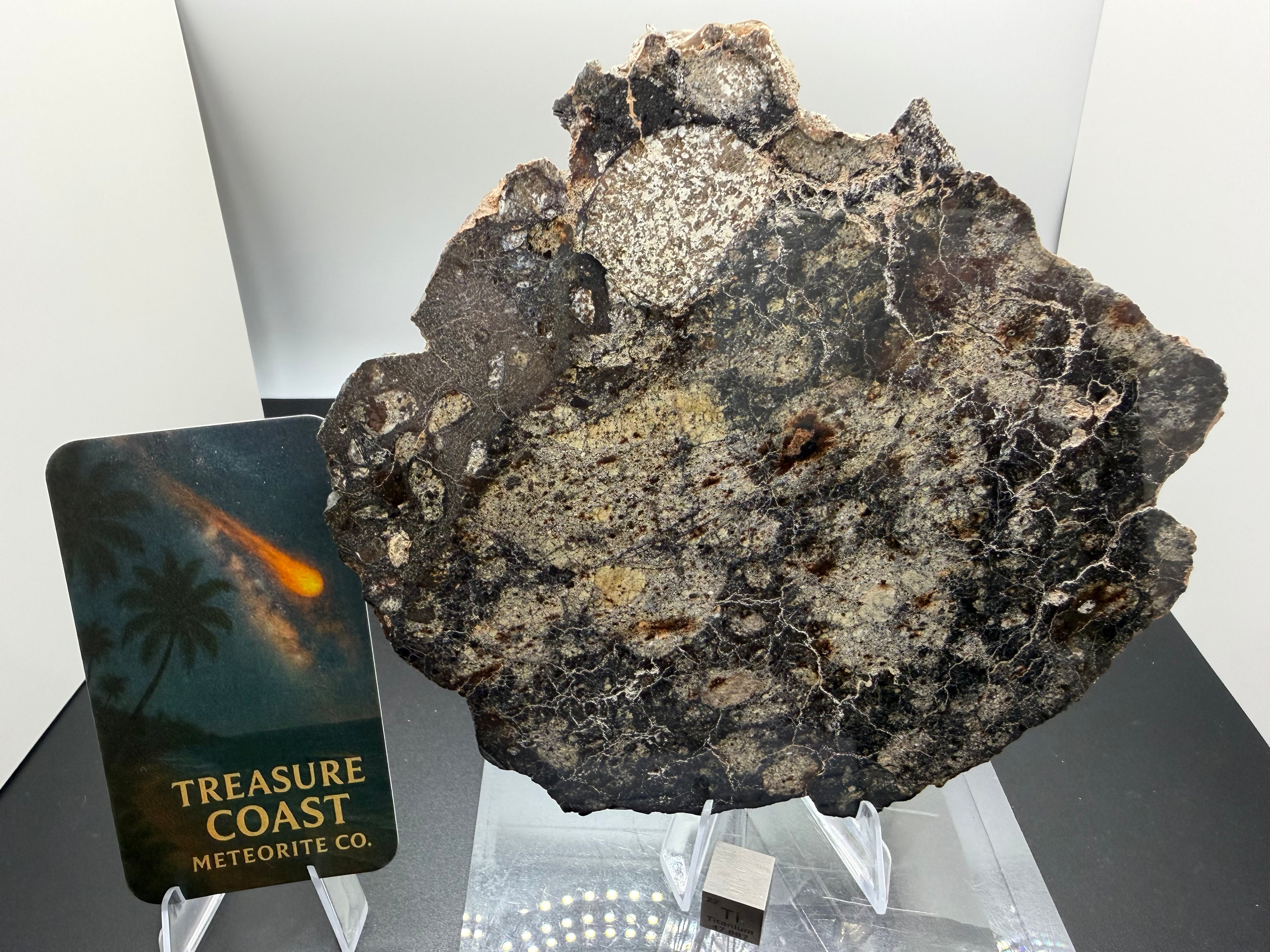
NWA 18048 Eucrite-pmict Meteorite Slice, 128.81g, Mirror Polished, Vivid Clast Boundaries
$520.00 USD
Sale price
$520.00 USD
Regular price
Skip to product information


NWA 18048 Eucrite-pmict Meteorite Slice, 128.81g, Mirror Polished, Vivid Clast Boundaries
Meteorite Details
Meteorite Name: NWA 18048
Subtype: Stony
Classification: Eucrite-pmict
Weight: 128.81 g
Year Found: 2024
Fall / Find: Find
Location: Northwest Africa

$520.00 USD
Sale price
$520.00 USD
Regular price
Large polished slice with defined clast structure
This 128.81g mirror-polished slice shows sharp boundaries between light and dark eucritic clasts suspended in an impact-generated matrix. The polish brings out textural contrast across the entire surface, making the polymict nature of this material immediately apparent. Thick melt veins cut through multiple clast types, recording the high-energy collisions that broke and reassembled Vesta's basaltic crust. The size allows clear observation of individual clast morphologies and their spatial relationships within the breccia framework.
The finish reveals internal detail without obscuring the primary brecciation. Clast shapes range from angular fragments to more rounded inclusions, indicating varying degrees of shock metamorphism and thermal processing during impact events. Matrix material fills the spaces between clasts, preserving a snapshot of the chaotic reassembly process that created this polymict lithology.
Polymict breccia formation on Vesta
Eucrite-pmict meteorites form when high-velocity impacts shatter Vesta's basaltic surface, mixing fragments of different eucritic compositions. The collision generates enough heat to produce local melting, creating the melt veins and darker matrix material that bind the clast assemblage together. This specimen preserves multiple generations of impact processing: the initial fragmentation of individual basaltic flows, their mechanical mixing, and subsequent welding by impact-generated melt.
The clast population includes both fine-grained and coarser-textured eucrite fragments, suggesting source materials from different depths or cooling histories within Vesta's crust. Some clasts show internal brecciation themselves, indicating they survived earlier impact events before incorporation into this polymict assemblage. The melt veins crosscut clast boundaries without thermal alteration of adjacent fragments, pointing to rapid quenching after the impact that created this breccia.
Vestan crust and the HED connection
Eucrites originate from asteroid 4 Vesta, the second-largest object in the main asteroid belt. NASA's Dawn spacecraft confirmed the connection between HED meteorites and Vesta through spectroscopic matching and surface imaging. Vesta differentiated early in solar system history, developing a basaltic crust similar to terrestrial oceanic crust. Eucrites sample this ancient igneous layer, providing direct evidence of planetary-scale melting and magmatic differentiation within the first few million years of solar system formation.
Polymict eucrites specifically record the impact history that modified Vesta's surface after initial crustal solidification. The large south polar impact basin excavated deep crustal and possibly mantle material, distributing ejecta across the asteroid and mixing different lithologies. This specimen represents that process at the hand sample scale. HED meteorites collectively offer one of the most complete records of early planetary evolution available for laboratory study. Learn more about meteorite classification and analysis at Learn About Meteorites.
Frequently asked questions
Is this meteorite authenticated? Yes. NWA 18048 is classified as eucrite-pmict by the Meteoritical Society. You can verify this classification in the Meteoritical Bulletin. This specimen includes a certificate of authenticity documenting its classification, weight, and provenance.
What does polymict mean in this context? Polymict describes a breccia containing clasts of multiple compositional or textural types. In this eucrite, the "pmict" designation indicates the presence of eucritic fragments from different basaltic sources, all mixed and cemented by impact processes on Vesta's surface. This distinguishes it from monomict eucrites, which contain clasts of a single uniform composition.
What is included with this specimen? You receive the 128.81g polished slice and a certificate of authenticity. No display stand is included.
Why is this specimen mirror polished? Mirror polishing maximizes contrast between clast types and matrix material, revealing internal structure that remains obscure on rough or fusion-crusted surfaces. The finish allows detailed examination of clast boundaries, melt vein relationships, and textural variation across the slice. Collectors and researchers use polished sections to study mineralogy, shock effects, and brecciation mechanisms in basaltic achondrites.
How does this specimen compare to other eucrites? Most eucrite meteorites on the market are unbrecciated basalts or small fragments of polymict material. A large polished slice showing clear clast structure occupies the intersection of scientific interest and display quality. The 128.81g mass provides enough surface area to observe multiple clast types and their spatial distribution within the breccia framework.
Display and collection value for HED specialists
Polymict eucrites represent a small fraction of classified HED meteorites, making them less common than unbrecciated basaltic eucrites. Large polished slices are further constrained by the economics of cutting and finishing, as most material from new finds is sold as smaller end cuts or broken fragments. This specimen combines size, preparation quality, and clear textural expression of the polymict lithology.
The mirror finish makes this slice suitable for both display and detailed examination. Clast boundaries remain sharp under magnification, and the polish does not obscure primary textures. For collectors building comprehensive HED suites, polymict eucrites fill a specific niche between simple basaltic samples and howardites. Institutional collections use specimens like this to teach impact processes, planetary differentiation, and asteroid geology in contexts where students can directly observe the physical evidence. Explore more Vestan material in the Eucrites and HED Meteorites collections.
Meteoritical Bulletin entry: NWA 18048 | Classification: Eucrite-pmict | Find, Northwest Africa, 2024